for two programs at a university, the type of student for two majors is as follows.\n| | history | science |…
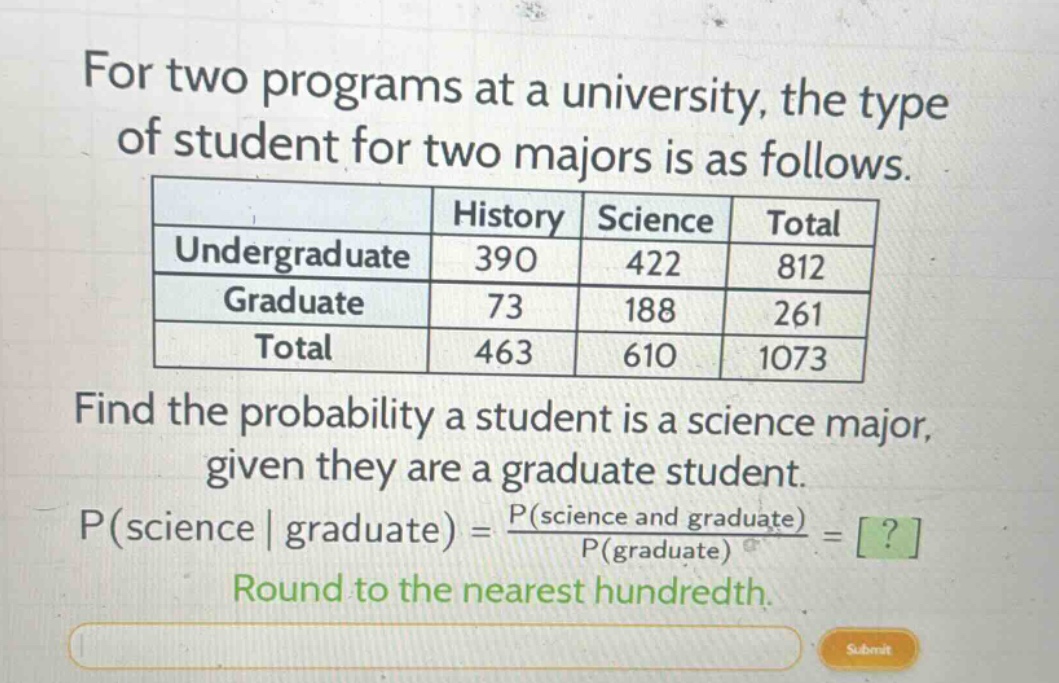
for two programs at a university, the type of student for two majors is as follows.\n| | history | science | total |\n|--|--|--|--|\n| undergraduate | 390 | 422 | 812 |\n| graduate | 73 | 188 | 261 |\n| total | 463 | 610 | 1073 |\nfind the probability a student is a science major, given they are a graduate student.\np(science | graduate) = \\frac{p(science and graduate)}{p(graduate)} = ?\nround to the nearest hundredth.
Answer
Explanation:
Step1: Identify the number of graduate students who are science majors.
From the table, the number of students who are both graduate students and science majors is 188. Let $N(\text{science and graduate})$ be this number. $$N(\text{science and graduate}) = 188$$
Step2: Identify the total number of graduate students.
From the table, the total number of graduate students is 261. Let $N(\text{graduate})$ be this number. $$N(\text{graduate}) = 261$$
Step3: Calculate the conditional probability.
The probability that a student is a science major, given they are a graduate student, is given by the formula: $$P(\text{science} | \text{graduate}) = \frac{N(\text{science and graduate})}{N(\text{graduate})}$$ Substitute the values from Step1 and Step2: $$P(\text{science} | \text{graduate}) = \frac{188}{261}$$
Step4: Calculate the value and round to the nearest hundredth.
Divide 188 by 261: $$\frac{188}{261} \approx 0.7203065134$$ Rounding to the nearest hundredth, we look at the third decimal place. Since it is 0 (which is less than 5), we keep the second decimal place as it is. $$P(\text{science} | \text{graduate}) \approx 0.72$$
Answer:
0.72