two sets of data are shown.\ndata set a: 30, 38, 42, 42, 43, 47, 51, 51, 57, 59\ndata set b: 38, 39, 40, 42…
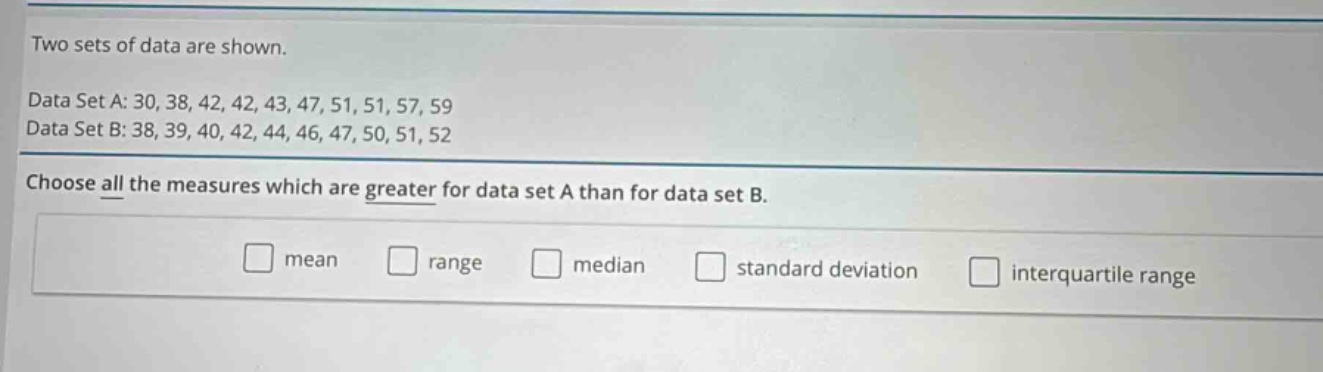
two sets of data are shown.\ndata set a: 30, 38, 42, 42, 43, 47, 51, 51, 57, 59\ndata set b: 38, 39, 40, 42, 44, 46, 47, 50, 51, 52\nchoose all the measures which are greater for data set a than for data set b.\nmean range median standard deviation interquartile range
Answer
Explanation:
Step1: Calculate the mean of Data Set A
Mean of Data Set A = $\frac{30 + 38+42+42+43+47+51+51+57+59}{10}=\frac{460}{10} = 46$
Step2: Calculate the mean of Data Set B
Mean of Data Set B = $\frac{38+39+40+42+44+46+47+50+51+52}{10}=\frac{449}{10}=44.9$
Step3: Calculate the range of Data Set A
Range of Data Set A = $59 - 30=29$
Step4: Calculate the range of Data Set B
Range of Data Set B = $52 - 38 = 14$
Step5: Calculate the median of Data Set A
Arrange Data Set A in order: 30, 38, 42, 42, 43, 47, 51, 51, 57, 59. Since $n = 10$ (even), median = $\frac{43 + 47}{2}=45$
Step6: Calculate the median of Data Set B
Arrange Data Set B in order: 38, 39, 40, 42, 44, 46, 47, 50, 51, 52. Since $n = 10$ (even), median = $\frac{44+46}{2}=45$
Step7: Calculate the standard - deviation of Data Set A
- Calculate the variance. First, find the deviation of each data - point from the mean: $(30 - 46)^2=256$, $(38 - 46)^2 = 64$, $(42-46)^2 = 16$, $(42 - 46)^2=16$, $(43 - 46)^2 = 9$, $(47 - 46)^2 = 1$, $(51 - 46)^2 = 25$, $(51 - 46)^2 = 25$, $(57 - 46)^2 = 121$, $(59 - 46)^2 = 169$ Sum of squared deviations = $256+64 + 16+16+9+1+25+25+121+169 = 692$ Variance $s_{A}^{2}=\frac{692}{10}=69.2$ Standard deviation $s_{A}=\sqrt{69.2}\approx8.32$
- Calculate the variance of Data Set B. First, find the deviation of each data - point from the mean: $(38 - 44.9)^2=47.61$, $(39 - 44.9)^2 = 34.81$, $(40 - 44.9)^2 = 24.01$, $(42 - 44.9)^2 = 8.41$, $(44 - 44.9)^2 = 0.81$, $(46 - 44.9)^2 = 1.21$, $(47 - 44.9)^2 = 4.41$, $(50 - 44.9)^2 = 26.01$, $(51 - 44.9)^2 = 37.21$, $(52 - 44.9)^2 = 50.41$ Sum of squared deviations = $47.61+34.81+24.01+8.41+0.81+1.21+4.41+26.01+37.21+50.41 = 234.9$ Variance $s_{B}^{2}=\frac{234.9}{10}=23.49$ Standard deviation $s_{B}=\sqrt{23.49}\approx4.85$
Step8: Calculate the inter - quartile range of Data Set A
- First, find the first quartile ($Q_1$) and third quartile ($Q_3$). The lower half of Data Set A: 30, 38, 42, 42, 43. The median of the lower half ($Q_1$) is 42. The upper half of Data Set A: 47, 51, 51, 57, 59. The median of the upper half ($Q_3$) is 51. Inter - quartile range of Data Set A ($IQR_A$)=$Q_3 - Q_1=51 - 42 = 9$
- For Data Set B: The lower half of Data Set B: 38, 39, 40, 42, 44. The median of the lower half ($Q_1$) is 40. The upper half of Data Set B: 47, 50, 51, 52. The median of the upper half ($Q_3$) is 50.5. Inter - quartile range of Data Set B ($IQR_B$)=$Q_3 - Q_1=50.5 - 40 = 10.5$
Answer:
mean, range, standard deviation