the two - way frequency table represents data from a survey asking a random sampling of people whether they…
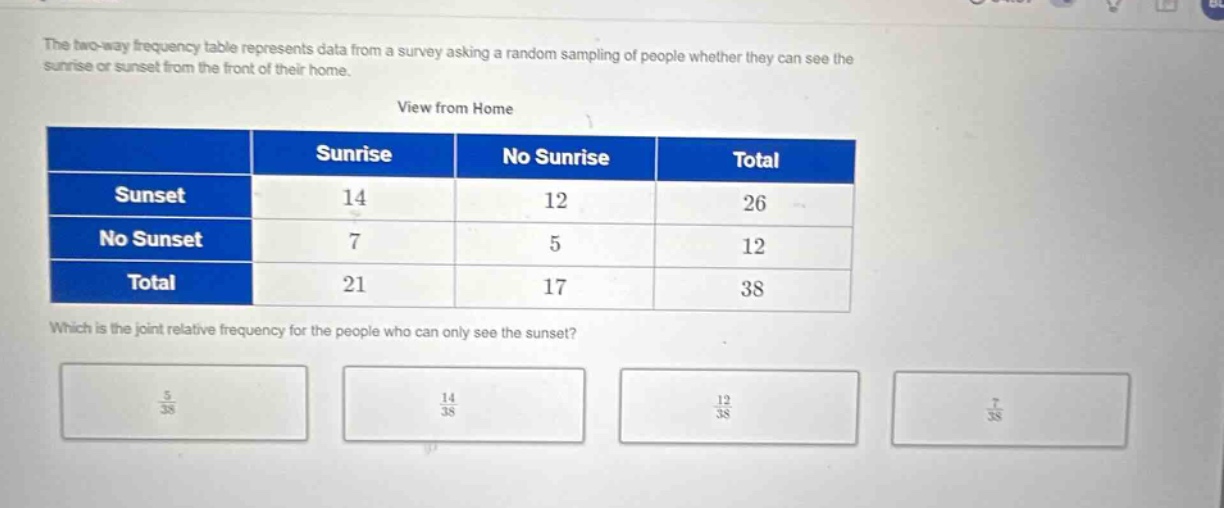
the two - way frequency table represents data from a survey asking a random sampling of people whether they can see the sunrise or sunset from the front of their home.\nview from home\n| |sunrise|no sunrise|total|\n|--|--|--|--|\n|sunset|14|12|26|\n|no sunset|7|5|12|\n|total|21|17|38|\nwhich is the joint relative frequency for the people who can only see the sunset?
Answer
Explanation:
Step1: Identify joint - frequency value
The number of people who can only see the sunset (can see sunset but no sunrise) is 14.
Step2: Calculate joint relative frequency
Joint relative frequency = $\frac{\text{Joint - frequency}}{\text{Total number of data points}}$. The total number of data points is 38. So the joint relative frequency is $\frac{14}{38}$.
Answer:
$\frac{14}{38}$