the two - way frequency table below shows data on twins in a patients family history and pregnancies with…
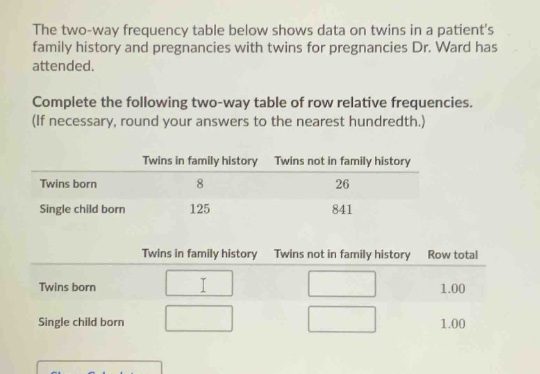
the two - way frequency table below shows data on twins in a patients family history and pregnancies with twins for pregnancies dr. ward has attended. complete the following two - way table of row relative frequencies. (if necessary, round your answers to the nearest hundredth.) twins in family history twins not in family history twins born 8 26 single child born 125 841 twins in family history twins not in family history row total twins born 1.00 single child born 1.00
Answer
Explanation:
Step1: Calculate row - total for 'Twins born'
The total number of 'Twins born' is $8 + 26=34$.
Step2: Calculate row - relative frequency for 'Twins born' with twins in family history
The row - relative frequency is $\frac{8}{34}\approx0.24$.
Step3: Calculate row - relative frequency for 'Twins born' with no twins in family history
The row - relative frequency is $\frac{26}{34}\approx0.76$.
Step4: Calculate row - total for 'Single child born'
The total number of 'Single child born' is $125+841 = 966$.
Step5: Calculate row - relative frequency for 'Single child born' with twins in family history
The row - relative frequency is $\frac{125}{966}\approx0.13$.
Step6: Calculate row - relative frequency for 'Single child born' with no twins in family history
The row - relative frequency is $\frac{841}{966}\approx0.87$.
Answer:
| Twins in family history | Twins not in family history | Row total | |
|---|---|---|---|
| Twins born | 0.24 | 0.76 | 1.00 |
| Single child born | 0.13 | 0.87 | 1.00 |