the two - way table represents data from a survey asking schoolchildren whether they are attending a summer…
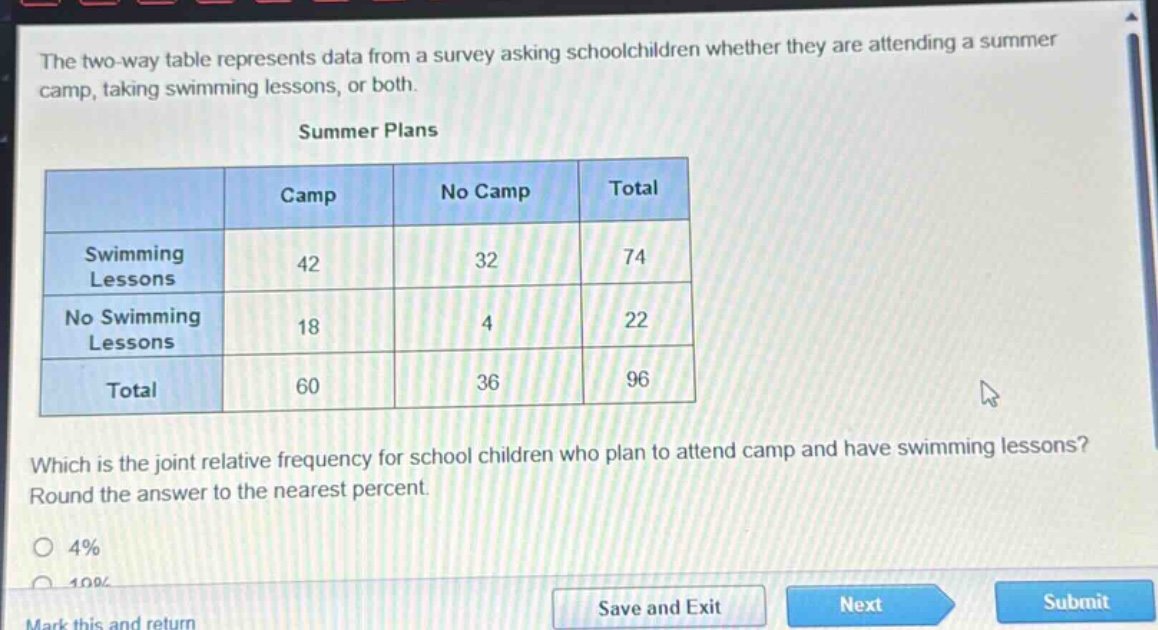
the two - way table represents data from a survey asking schoolchildren whether they are attending a summer camp, taking swimming lessons, or both.\nsummer plans\n| | camp | no camp | total |\n|--|--|--|--|\n| swimming lessons | 42 | 32 | 74 |\n| no swimming lessons | 18 | 4 | 22 |\n| total | 60 | 36 | 96 |\nwhich is the joint relative frequency for school children who plan to attend camp and have swimming lessons? round the answer to the nearest percent.\n4%\n10%
Answer
Explanation:
Step1: Identify the number of students attending camp and swimming lessons.
From the table, the number of schoolchildren who plan to attend camp and have swimming lessons is 42.
Step2: Identify the total number of students surveyed.
From the table, the total number of schoolchildren surveyed is 96.
Step3: Calculate the joint relative frequency.
The joint relative frequency is the number of students attending camp and swimming lessons divided by the total number of students. $$ \text{Joint Relative Frequency} = \frac{\text{Number of students attending camp and swimming lessons}}{\text{Total number of students}} $$ $$ \text{Joint Relative Frequency} = \frac{42}{96} $$
Step4: Convert to a percentage and round.
To convert the fraction to a percentage, multiply by 100 and round to the nearest percent. $$ \text{Percentage} = \frac{42}{96} \times 100% $$ $$ \text{Percentage} \approx 0.4375 \times 100% $$ $$ \text{Percentage} \approx 43.75% $$ Rounding to the nearest percent gives 44%.
Answer:
44%