the two - way table shows the number of sport utility vehicles with certain features for sale at the car…
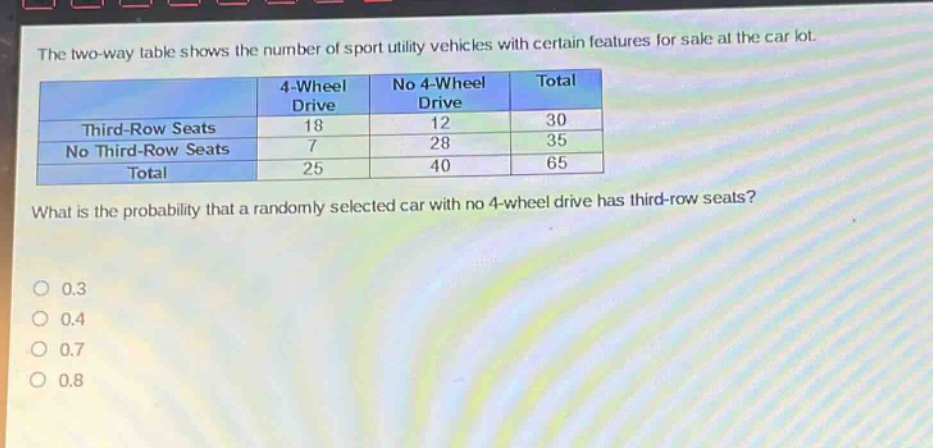
the two - way table shows the number of sport utility vehicles with certain features for sale at the car lot.\n| |4 - wheel drive|no 4 - wheel drive|total| \n|--|--|--|--| \n|third - row seats|18|12|30| \n|no third - row seats|7|28|35| \n|total|25|40|65| \nwhat is the probability that a randomly selected car with no 4 - wheel drive has third - row seats?\n0.3\n0.4\n0.7\n0.8
Answer
Explanation:
Step1: Identify relevant values
We want P(third - row seats | no 4 - wheel drive). The number of cars with no 4 - wheel drive and third - row seats is 12, and the total number of cars with no 4 - wheel drive is 40.
Step2: Apply conditional probability formula
The formula for conditional probability P(A|B)=$\frac{P(A\cap B)}{P(B)}$. In terms of counts, P(A|B)=$\frac{n(A\cap B)}{n(B)}$. Here, n(A\cap B) = 12 (no 4 - wheel drive and third - row seats) and n(B)=40 (no 4 - wheel drive). So the probability is $\frac{12}{40}$.
Step3: Simplify the fraction
$\frac{12}{40}=\frac{3}{10}=0.3$
Answer:
0.3