the two - way table shows the preferred vacation destination for people in different age groups.\n| | hawaii…
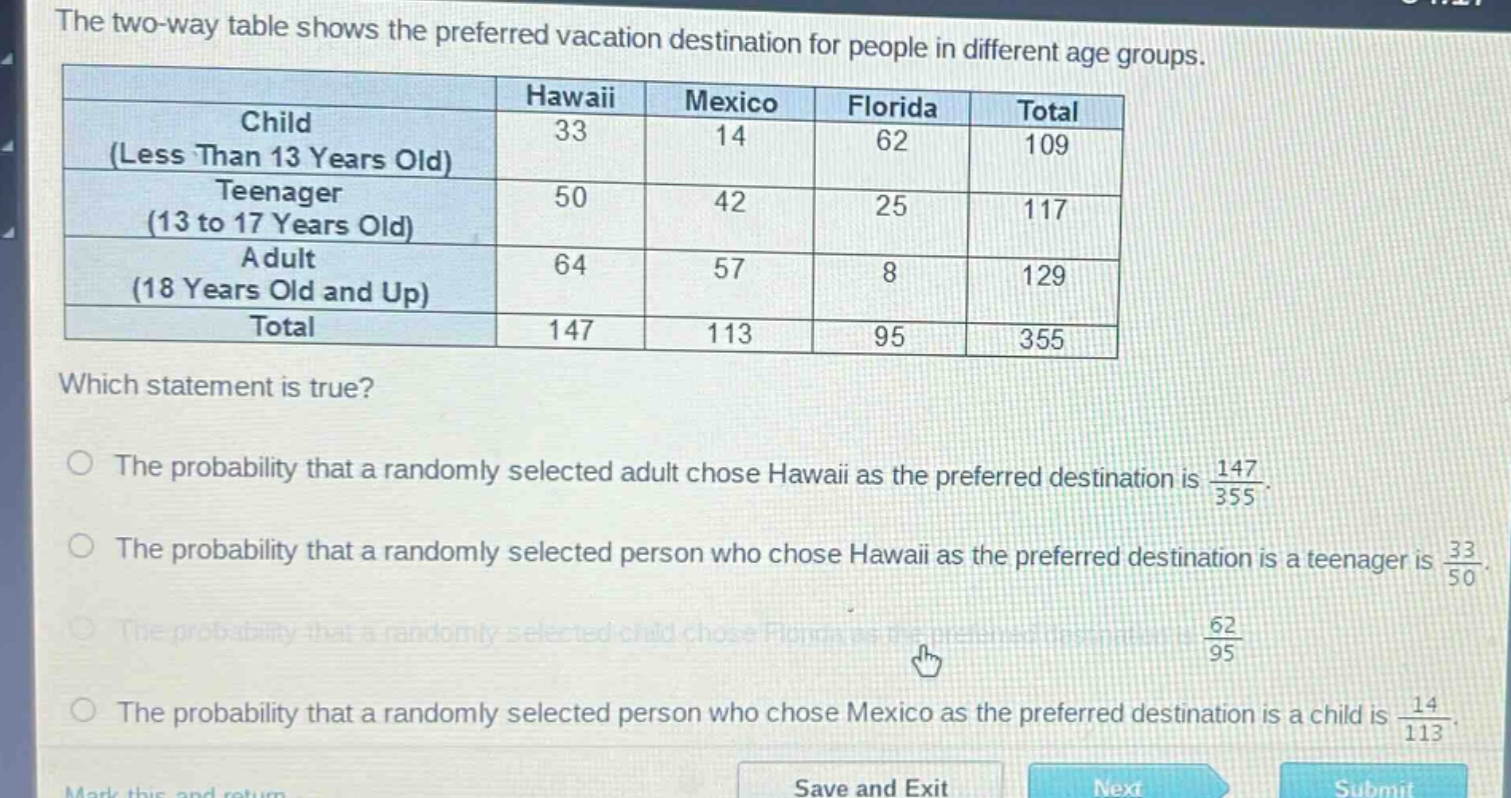
the two - way table shows the preferred vacation destination for people in different age groups.\n| | hawaii | mexico | florida | total |\n|--|--|--|--|--|\n| child (less than 13 years old) | 33 | 14 | 62 | 109 |\n| teenager (13 to 17 years old) | 50 | 42 | 25 | 117 |\n| adult (18 years old and up) | 64 | 57 | 8 | 129 |\n| total | 147 | 113 | 95 | 355 |\nwhich statement is true?\nthe probability that a randomly selected adult chose hawaii as the preferred destination is $\frac{147}{355}$.\nthe probability that a randomly selected person who chose hawaii as the preferred destination is a teenager is $\frac{33}{50}$.\nthe probability that a randomly selected child chose florida as the preferred destination is $\frac{62}{95}$.\nthe probability that a randomly selected person who chose mexico as the preferred destination is a child is $\frac{14}{113}$.
Answer
Explanation:
Step1: Recall probability formula
Probability = $\frac{\text{Number of favorable outcomes}}{\text{Total number of outcomes}}$.
Step2: Analyze first - statement
The number of adults who chose Hawaii is 64, and the total number of people is 355. The probability that a randomly - selected adult chose Hawaii is $\frac{64}{129}$ (not $\frac{147}{355}$), so this statement is false.
Step3: Analyze second - statement
The number of teenagers who chose Hawaii is 50, and the total number of people who chose Hawaii is 147. The probability that a randomly - selected person who chose Hawaii is a teenager is $\frac{50}{147}$ (not $\frac{33}{50}$), so this statement is false.
Step4: Analyze third - statement
The number of children who chose Florida is 62, and the total number of people who chose Florida is 95. The probability that a randomly - selected child chose Florida is $\frac{62}{109}$ (not $\frac{62}{95}$), so this statement is false.
Step5: Analyze fourth - statement
The number of children who chose Mexico is 14, and the total number of people who chose Mexico is 113. The probability that a randomly - selected person who chose Mexico is a child is $\frac{14}{113}$, so this statement is true.
Answer:
The probability that a randomly selected person who chose Mexico as the preferred destination is a child is $\frac{14}{113}$.