the two - way table shows the preferred vacation destination for people in different age groups.\n| | hawaii…
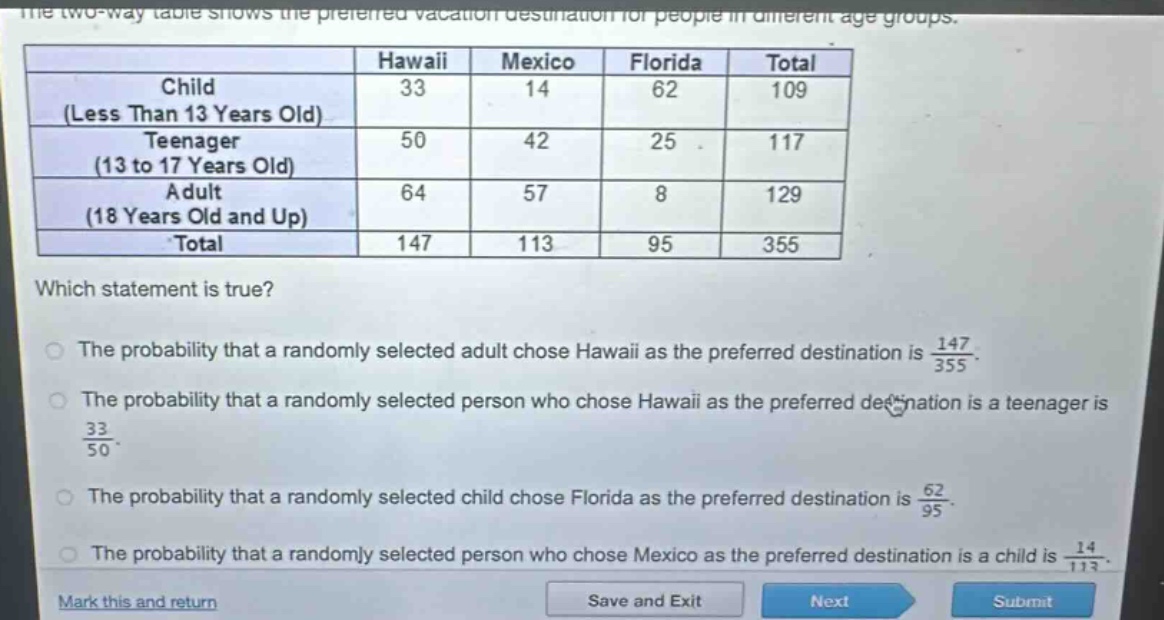
the two - way table shows the preferred vacation destination for people in different age groups.\n| | hawaii | mexico | florida | total |\n|--|--|--|--|--|\n| child (less than 13 years old) | 33 | 14 | 62 | 109 |\n| teenager (13 to 17 years old) | 50 | 42 | 25 | 117 |\n| adult (18 years old and up) | 64 | 57 | 8 | 129 |\n| total | 147 | 113 | 95 | 355 |\nwhich statement is true?\nthe probability that a randomly selected adult chose hawaii as the preferred destination is $\frac{147}{355}$.\nthe probability that a randomly selected person who chose hawaii as the preferred destination is a teenager is $\frac{33}{50}$.\nthe probability that a randomly selected child chose florida as the preferred destination is $\frac{62}{95}$.\nthe probability that a randomly selected person who chose mexico as the preferred destination is a child is $\frac{14}{113}$.\nmark this and return save and exit next submit
Answer
Answer:
The probability that a randomly selected child chose Florida as the preferred destination is $\frac{62}{109}$.
Explanation:
Step1: Recall probability formula
$P(A)=\frac{\text{Number of favorable outcomes}}{\text{Total number of outcomes}}$
Step2: Analyze first option
Number of adults who chose Hawaii is 64, total number of people is 355. Probability is $\frac{64}{355}\neq\frac{147}{355}$.
Step3: Analyze second option
Number of teenagers who chose Hawaii is 50, total number of people who chose Hawaii is 147. Probability is $\frac{50}{147}\neq\frac{33}{50}$.
Step4: Analyze third option
Number of children who chose Florida is 62, total number of children is 109. Probability is $\frac{62}{109}$.
Step5: Analyze fourth option
Number of children who chose Mexico is 14, total number of people who chose Mexico is 113. Probability is $\frac{14}{113}$, but this is not the correct way to calculate the probability for the given statement context. The correct probability for a person who chose Mexico to be a child should be $\frac{14}{113}$ considering the whole - group perspective for Mexico - choosers, but the statement's framing is not in line with standard conditional probability interpretation as presented in the table context. The third option is the correct probability statement based on the table data.