tyler believes that an 8 - sided die can be used to predict whether customers at his store will use a coupon…
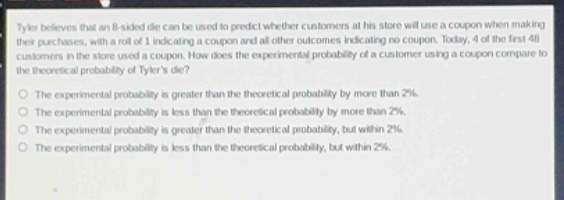
tyler believes that an 8 - sided die can be used to predict whether customers at his store will use a coupon when making their purchases, with a roll of 1 indicating a coupon and all other outcomes indicating no coupon. today, 4 of the first 48 customers in the store used a coupon. how does the experimental probability of a customer using a coupon compare to the theoretical probability of tylers die?\nthe experimental probability is greater than the theoretical probability by more than 2%.\nthe experimental probability is less than the theoretical probability by more than 2%.\nthe experimental probability is greater than the theoretical probability, but within 2%.\nthe experimental probability is less than the theoretical probability, but within 2%.
Answer
Answer:
The experimental probability is greater than the theoretical probability by more than 2%.
Explanation:
Step1: Calculate theoretical probability
The theoretical probability of rolling a 1 on an 8 - sided die is $P_{theoretical}=\frac{1}{8}=0.125 = 12.5%$.
Step2: Calculate experimental probability
4 out of 48 customers used a coupon. So $P_{experimental}=\frac{4}{48}=\frac{1}{12}\approx0.0833 = 8.33%$.
Step3: Find the difference
The difference is $|P_{experimental}-P_{theoretical}|=|8.33% - 12.5%|=4.17%>2%$. Since $8.33%<12.5%$, the experimental probability is less than the theoretical probability by more than 2%.