type the correct answer in the box. a local grocery store tested spinach samples for e coli bacteria using…
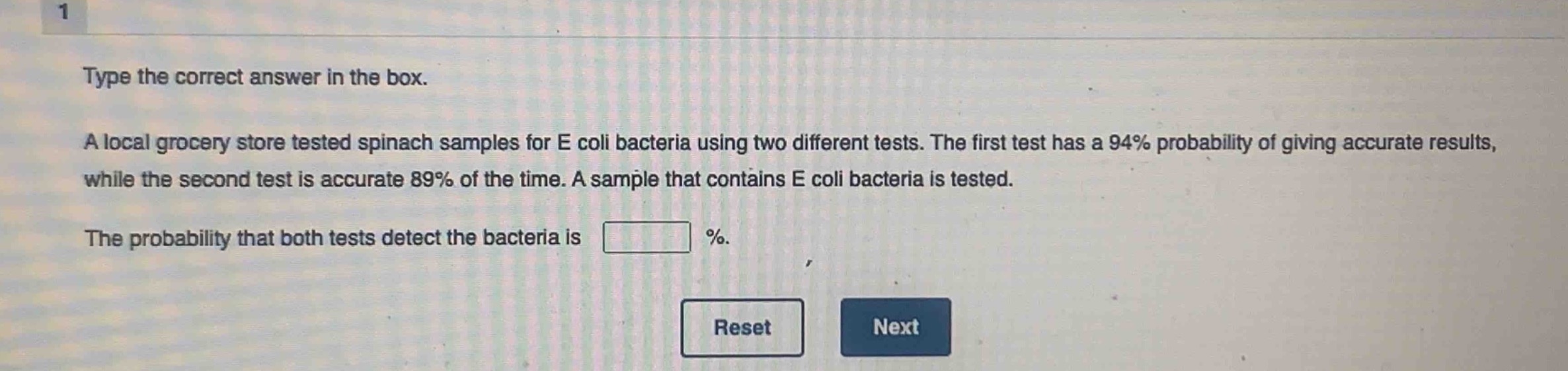
type the correct answer in the box. a local grocery store tested spinach samples for e coli bacteria using two different tests. the first test has a 94% probability of giving accurate results, while the second test is accurate 89% of the time. a sample that contains e coli bacteria is tested. the probability that both tests detect the bacteria is %.
Answer
Explanation:
Step1: Identify the probabilities
Let $P(A)=0.94$ be the probability of the first - test being accurate and $P(B)=0.89$ be the probability of the second - test being accurate.
Step2: Use the multiplication rule for independent events
Since the two tests are independent, the probability that both tests are accurate (both detect the bacteria) is $P(A\cap B)=P(A)\times P(B)$. $P(A\cap B)=0.94\times0.89 = 0.8366$.
Step3: Convert to percentage
To convert the decimal to a percentage, multiply by 100. $0.8366\times100 = 83.66$.
Answer:
83.66