type the correct answer in each box. a few people who have a particular disease take part in a medical trial…
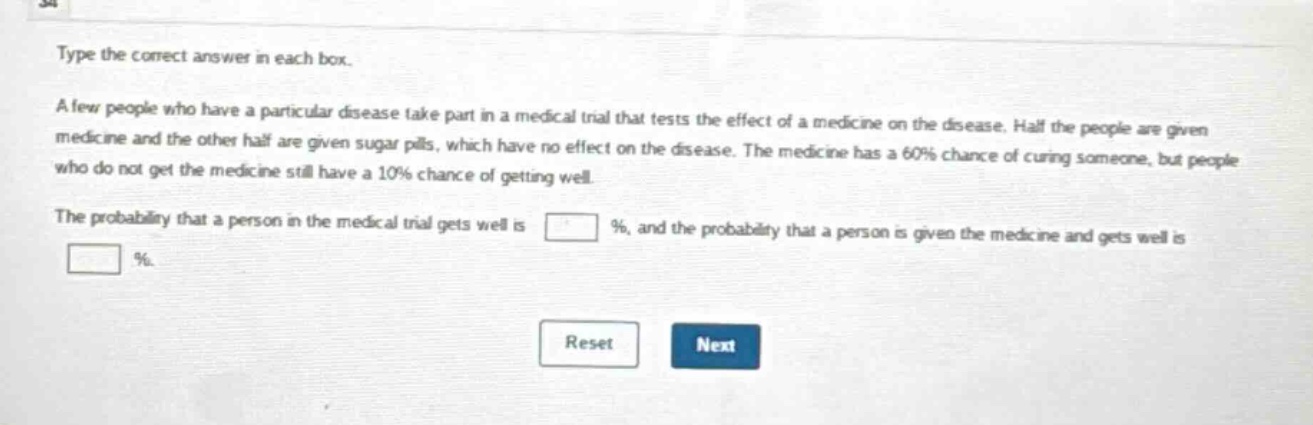
type the correct answer in each box. a few people who have a particular disease take part in a medical trial that tests the effect of a medicine on the disease. half the people are given medicine and the other half are given sugar pills, which have no effect on the disease. the medicine has a 60% chance of curing someone, but people who do not get the medicine still have a 10% chance of getting well. the probability that a person in the medical trial gets well is % , and the probability that a person is given the medicine and gets well is % .
Answer
Explanation:
Step1: Calculate probability of getting well considering both groups
Let's assume there are a total of (n) people in the trial. Half ((\frac{n}{2})) get the medicine and half ((\frac{n}{2})) get sugar - pills. The probability of getting well for those who get the medicine is (P(\text{well}|\text{medicine}) = 0.6), and the probability of getting well for those who don't get the medicine is (P(\text{well}|\text{no - medicine})=0.1). Using the law of total probability (P(\text{well})=P(\text{medicine})\times P(\text{well}|\text{medicine})+P(\text{no - medicine})\times P(\text{well}|\text{no - medicine})). Since (P(\text{medicine}) = P(\text{no - medicine})=0.5), we have (P(\text{well})=0.5\times0.6 + 0.5\times0.1). [P(\text{well})=0.5\times(0.6 + 0.1)=0.5\times0.7 = 0.35=35%]
Step2: Calculate probability of getting medicine and getting well
The probability of getting the medicine is (P(\text{medicine}) = 0.5), and the probability of getting well given that one has the medicine is (P(\text{well}|\text{medicine}) = 0.6). By the formula for joint - probability (P(\text{medicine and well})=P(\text{medicine})\times P(\text{well}|\text{medicine})). [P(\text{medicine and well})=0.5\times0.6=0.3 = 30%]
Answer:
35 30