type the correct answer in the box. in a relay race, the probability of the galaxy team winning is 22%. in…
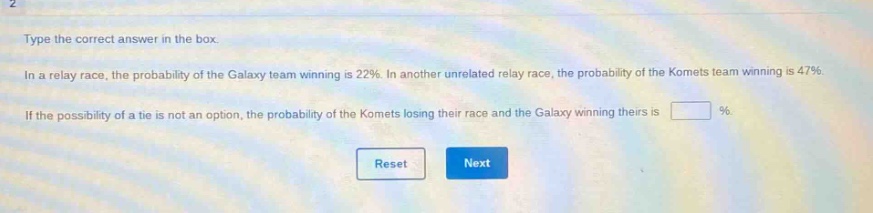
type the correct answer in the box. in a relay race, the probability of the galaxy team winning is 22%. in another unrelated relay race, the probability of the komets team winning is 47%. if the possibility of a tie is not an option, the probability of the komets losing their race and the galaxy winning theirs is %.
Answer
Explanation:
Step1: Find probability of Komets losing
The probability of an event happening and not - happening sums to 1. If the probability of the Komets team winning is $P(K_w)=47% = 0.47$, then the probability of the Komets team losing, $P(K_l)=1 - 0.47=0.53$.
Step2: Find combined probability
Since the two races are unrelated (independent events), the probability of the Komets losing their race and the Galaxy winning theirs is the product of their individual probabilities. The probability of the Galaxy team winning is $P(G_w)=22% = 0.22$. So the combined probability $P = P(K_l)\times P(G_w)$. $P=0.53\times0.22 = 0.1166$. Converting to percentage, $0.1166\times100 = 11.66%$.
Answer:
11.66