type the correct answer in each box. use numerals instead of words. if necessary, use / for the fraction…
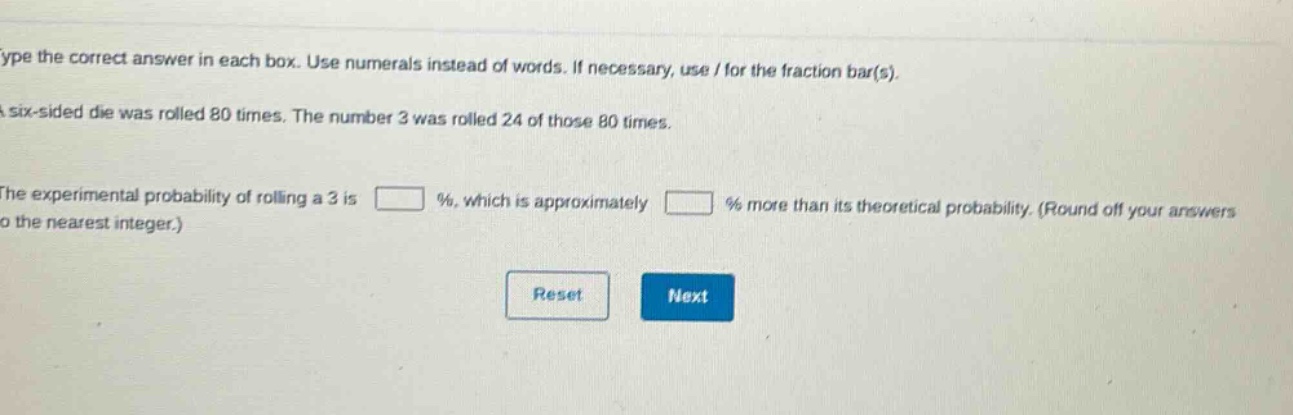
type the correct answer in each box. use numerals instead of words. if necessary, use / for the fraction bar(s). a six - sided die was rolled 80 times. the number 3 was rolled 24 of those 80 times. the experimental probability of rolling a 3 is % , which is approximately % more than its theoretical probability. (round off your answers to the nearest integer.)
Answer
Explanation:
Step1: Calculate experimental probability
Experimental probability = $\frac{\text{Number of times 3 occurred}}{\text{Total number of rolls}}\times100%$. Given number of times 3 occurred is 24 and total number of rolls is 80. So, experimental probability = $\frac{24}{80}\times100% = 30%$.
Step2: Calculate theoretical probability
For a fair six - sided die, the theoretical probability of rolling a 3 is $\frac{1}{6}\times100%\approx16.67%$.
Step3: Calculate the difference
Difference = Experimental probability - Theoretical probability. So, difference = $30% - 16.67% \approx 13%$.
Answer:
30, 13