type the correct answer in each box. use numerals instead of words. if necessary, use / for the fraction…
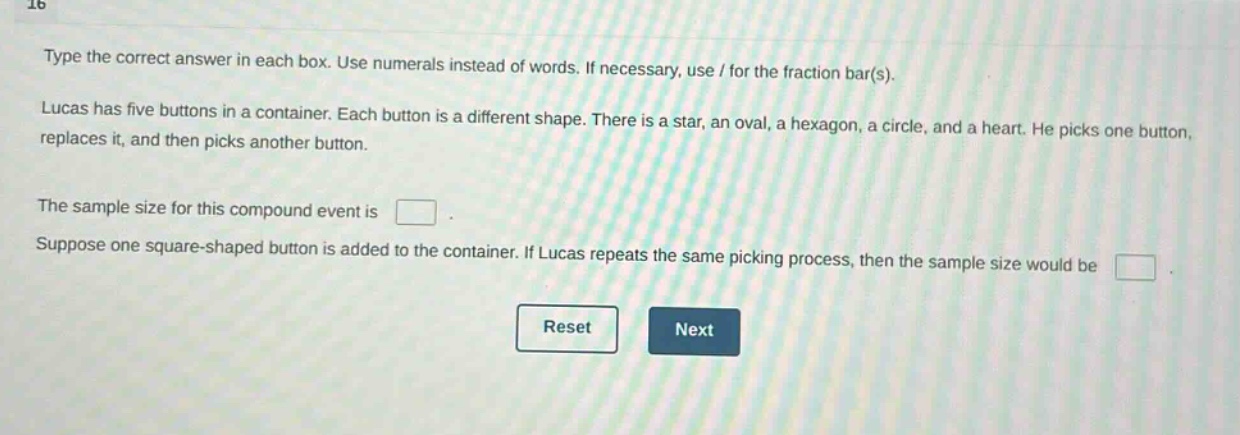
type the correct answer in each box. use numerals instead of words. if necessary, use / for the fraction bar(s). lucas has five buttons in a container. each button is a different shape. there is a star, an oval, a hexagon, a circle, and a heart. he picks one button, replaces it, and then picks another button. the sample size for this compound event is . suppose one square - shaped button is added to the container. if lucas repeats the same picking process, then the sample size would be . reset next
Answer
Explanation:
Step1: Calculate initial sample - size
For the first case, there are 5 buttons. Since the picking is with replacement, for the first pick there are 5 options and for the second pick there are also 5 options. By the multiplication principle, the sample - size $n_1=5\times5 = 25$.
Step2: Calculate new sample - size
When one more button is added, there are 6 buttons. Again, since the picking is with replacement, for the first pick there are 6 options and for the second pick there are 6 options. By the multiplication principle, the sample - size $n_2=6\times6=36$.
Answer:
25 36