type the correct answer in the box. use numerals instead of words. if necessary, use / for the fraction…
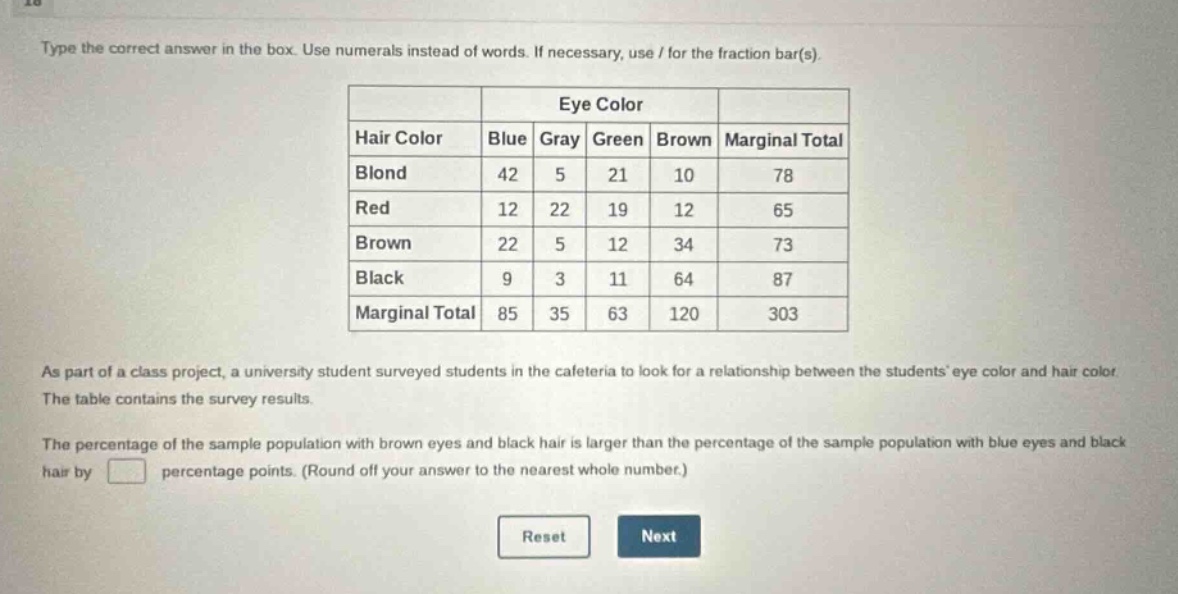
type the correct answer in the box. use numerals instead of words. if necessary, use / for the fraction bar(s). as part of a class project, a university student surveyed students in the cafeteria to look for a relationship between the students eye color and hair color. the table contains the survey results. the percentage of the sample population with brown eyes and black hair is larger than the percentage of the sample population with blue eyes and black hair by percentage points. (round off your answer to the nearest whole number.)
Answer
Explanation:
Step1: Calculate percentage of brown - eyed and black - haired
The number of students with brown eyes and black hair is 64. The total number of students in the sample is 303. The percentage is $\frac{64}{303}\times100\approx 21.12%$.
Step2: Calculate percentage of blue - eyed and black - haired
The number of students with blue eyes and black hair is 9. The total number of students in the sample is 303. The percentage is $\frac{9}{303}\times100\approx 2.97%$.
Step3: Calculate the difference
Subtract the percentage of blue - eyed and black - haired from the percentage of brown - eyed and black - haired: $21.12 - 2.97=18.15\approx18$.
Answer:
18