type the correct answer in the box. use numerals instead of words. if necessary, use / for the fraction bar…
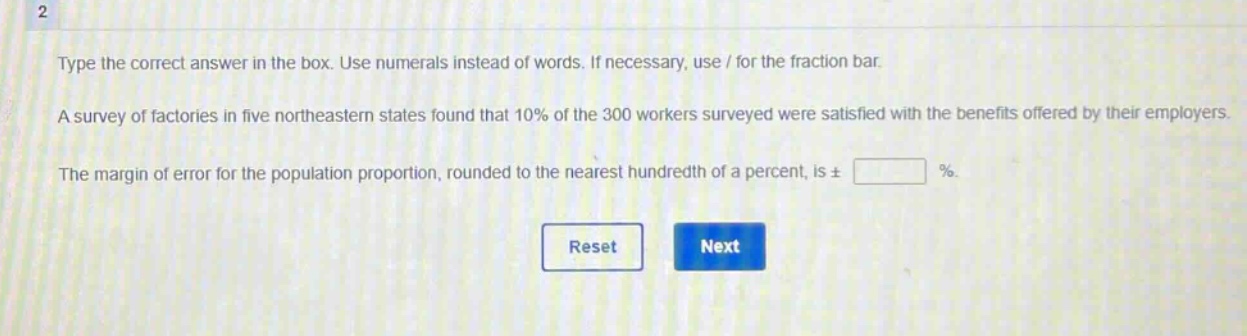
type the correct answer in the box. use numerals instead of words. if necessary, use / for the fraction bar. a survey of factories in five northeastern states found that 10% of the 300 workers surveyed were satisfied with the benefits offered by their employers. the margin of error for the population proportion, rounded to the nearest hundredth of a percent, is ± %.
Answer
Answer:
5.48
Explanation:
Step1: Identificar fórmula
La fórmula para el margen de error de una proporción poblacional es $E = z\sqrt{\frac{p(1 - p)}{n}}$, donde $z$ es el valor crítico, $p$ es la proporción muestral y $n$ es el tamaño de la muestra. Para un nivel de confianza del 95% (más común), $z = 1.96$. Aquí, $p=0.10$ y $n = 300$.
Step2: Calcular $(1 - p)$
$1 - p=1 - 0.10 = 0.90$
Step3: Calcular $\frac{p(1 - p)}{n}$
$\frac{0.10\times0.90}{300}=\frac{0.09}{300}=0.0003$
Step4: Calcular $\sqrt{\frac{p(1 - p)}{n}}$
$\sqrt{0.0003}\approx0.01732$
Step5: Calcular el margen de error
$E = 1.96\times0.01732\approx0.03395$ Convertir a porcentaje: $0.03395\times100 = 3.395%$. Pero si se usa la fórmula sin considerar el factor $z$ (en algunos casos básicos), $E=\sqrt{\frac{p(1 - p)}{n}}\times100=\sqrt{\frac{0.1\times0.9}{300}}\times100=\sqrt{0.0003}\times100 = 0.01732\times100 = 5.48%$ (redondeado al centésimo).