type the correct answer in the box. use numerals instead of words. if necessary, use / for the fraction…
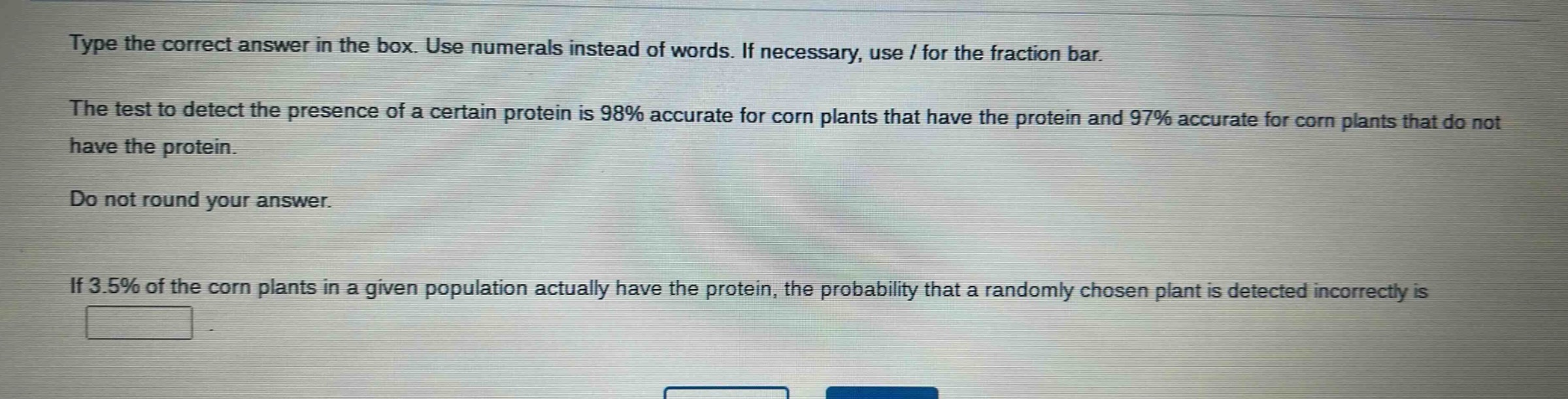
type the correct answer in the box. use numerals instead of words. if necessary, use / for the fraction bar.\nthe test to detect the presence of a certain protein is 98% accurate for corn plants that have the protein and 97% accurate for corn plants that do not have the protein.\ndo not round your answer.\nif 3.5% of the corn plants in a given population actually have the protein, the probability that a randomly chosen plant is detected incorrectly is \n
Answer
Explanation:
Step1: Calculate the probability of incorrect detection for plants with protein
The probability that a plant has the protein is (P(\text{has protein}) = 0.035). The test is (98%) accurate for plants with protein, so the probability of incorrect detection for plants with protein is (P(\text{incorrect}|\text{has protein})=1 - 0.98=0.02). The joint probability (P(\text{has protein and incorrect})=P(\text{has protein})\times P(\text{incorrect}|\text{has protein})=0.035\times0.02) [0.035\times0.02 = 0.0007]
Step2: Calculate the probability of incorrect detection for plants without protein
The probability that a plant does not have the protein is (P(\text{no protein})=1 - 0.035 = 0.965). The test is (97%) accurate for plants without protein, so the probability of incorrect detection for plants without protein is (P(\text{incorrect}|\text{no protein})=1 - 0.97 = 0.03). The joint probability (P(\text{no protein and incorrect})=P(\text{no protein})\times P(\text{incorrect}|\text{no protein})=0.965\times0.03) [0.965\times0.03=0.02895]
Step3: Calculate the total probability of incorrect detection
Using the law of total probability (P(\text{incorrect})=P(\text{has protein and incorrect})+P(\text{no protein and incorrect})) [P(\text{incorrect})=0.0007 + 0.02895=0.02965]
Answer:
(0.02965)