type the correct answer in each box. use numerals instead of words. if necessary, use / for the fraction…
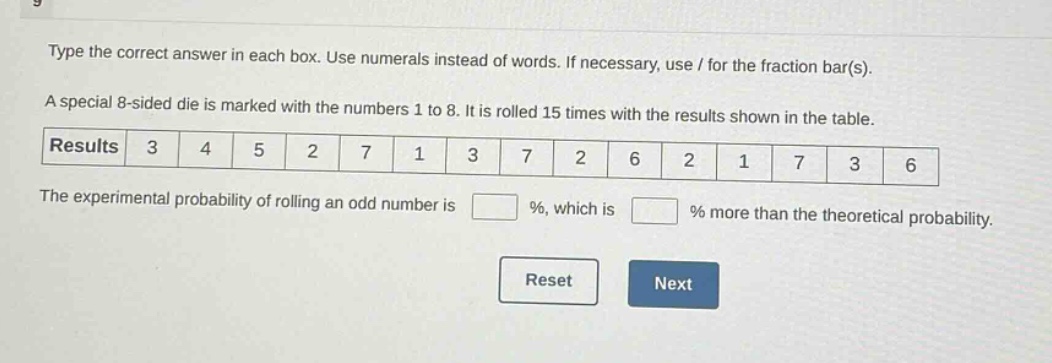
type the correct answer in each box. use numerals instead of words. if necessary, use / for the fraction bar(s). a special 8 - sided die is marked with the numbers 1 to 8. it is rolled 15 times with the results shown in the table. results 3 4 5 2 7 1 3 7 2 6 2 1 7 3 6 the experimental probability of rolling an odd number is % , which is % more than the theoretical probability. reset next
Answer
Explanation:
Step1: Count odd - numbered results
The odd - numbered results in the table are 3, 5, 7, 1, 3, 7, 1, 7, 3. Counting them, we find there are 9 odd - numbered results out of 15 rolls.
Step2: Calculate experimental probability
The experimental probability (P_{exp}) of rolling an odd number is the number of favorable outcomes (rolling an odd number) divided by the total number of outcomes. So (P_{exp}=\frac{9}{15}=0.6 = 60%).
Step3: Calculate theoretical probability
A fair 8 - sided die has 4 odd numbers (1, 3, 5, 7) out of 8 numbers. The theoretical probability (P_{theo}=\frac{4}{8}=0.5 = 50%).
Step4: Calculate the difference
The difference between the experimental and theoretical probabilities is (60 - 50=10%).
Answer:
60, 10