type the correct answer in each box. use numerals instead of words.\na new test is developed to test for…
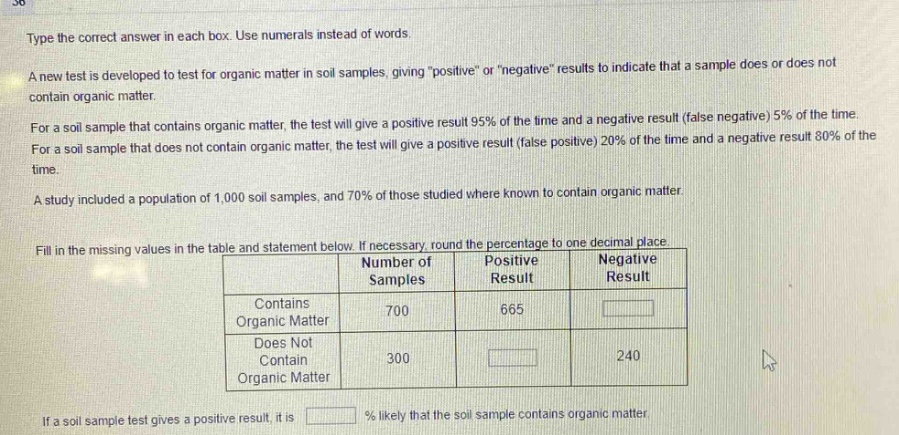
type the correct answer in each box. use numerals instead of words.\na new test is developed to test for organic matter in soil samples, giving \positive\ or \negative\ results to indicate that a sample does or does not contain organic matter.\nfor a soil sample that contains organic matter, the test will give a positive result 95% of the time and a negative result (false negative) 5% of the time. for a soil sample that does not contain organic matter, the test will give a positive result (false positive) 20% of the time and a negative result 80% of the time.\na study included a population of 1,000 soil samples, and 70% of those studied where known to contain organic matter.\nfill in the missing values in the table and statement below. if necessary, round the percentage to one decimal place.\n| | number of samples | positive result | negative result |\n|--|--|--|--|\n| contains organic matter | 700 | 665 | |\n| does not contain organic matter | 300 | | 240 |\nif a soil sample test gives a positive result, it is % likely that the soil sample contains organic matter.
Answer
Explanation:
Step1: Calculate false - negative number
The number of soil samples that contain organic matter is 700. The false - negative rate for samples with organic matter is 5%. So the number of false - negative results (negative result for samples with organic matter) is $700\times0.05 = 35$.
Step2: Calculate false - positive number
The number of soil samples that do not contain organic matter is 300. The false - positive rate for samples without organic matter is 20%. So the number of false - positive results (positive result for samples without organic matter) is $300\times0.2=60$.
Step3: Calculate total positive results
The total number of positive results is the sum of true - positive (665) and false - positive (60), so $665 + 60=725$.
Step4: Calculate the probability
The probability that a soil sample contains organic matter given a positive result is calculated using Bayes' theorem. The number of positive results for samples with organic matter is 665, and the total number of positive results is 725. The probability is $\frac{665}{725}\times100%\approx91.7%$.
Answer:
35 60 91.7