type the correct answer in the box. use numerals instead of words. for this problem, a non - integer answer…
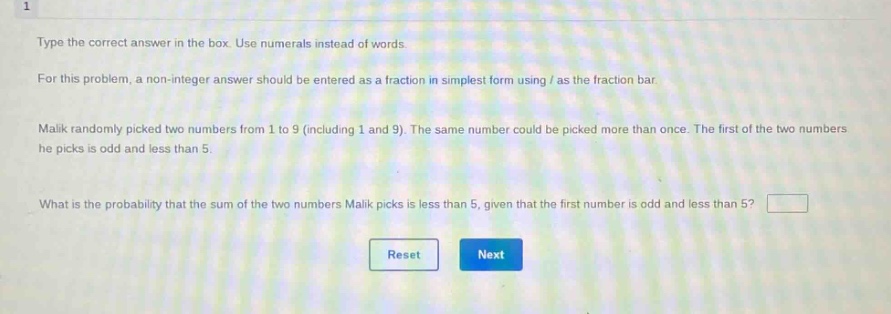
type the correct answer in the box. use numerals instead of words. for this problem, a non - integer answer should be entered as a fraction in simplest form using / as the fraction bar. malik randomly picked two numbers from 1 to 9 (including 1 and 9). the same number could be picked more than once. the first of the two numbers he picks is odd and less than 5. what is the probability that the sum of the two numbers malik picks is less than 5, given that the first number is odd and less than 5?
Answer
Explanation:
Step1: Determine the first - number possibilities
The first number is odd and less than 5. So the possible values for the first number are 1 and 3.
Step2: Calculate the total number of cases for the second - number
Since the second number can be any number from 1 to 9, for each of the 2 possible first - numbers (1 and 3), there are 9 possible second - numbers. So the total number of cases for the two - number selection given the condition on the first number is (n = 2\times9=18).
Step3: Find the favorable cases
Case 1: If the first number (a = 1): Let the second number be (b). We want (a + b<5), i.e., (1 + b<5) or (b < 4). So (b) can be 1, 2, 3. There are 3 possibilities. Case 2: If the first number (a = 3): We want (a + b<5), i.e., (3 + b<5) or (b < 2). So (b) can be 1. There is 1 possibility. The total number of favorable cases (m=3 + 1=4).
Step4: Calculate the probability
The probability (P=\frac{m}{n}). Substituting (m = 4) and (n = 18), we get (P=\frac{4}{18}=\frac{2}{9}).
Answer:
(\frac{2}{9})