type the correct answer in the box. use numerals instead of words.\nthe test to determine the presence of a…
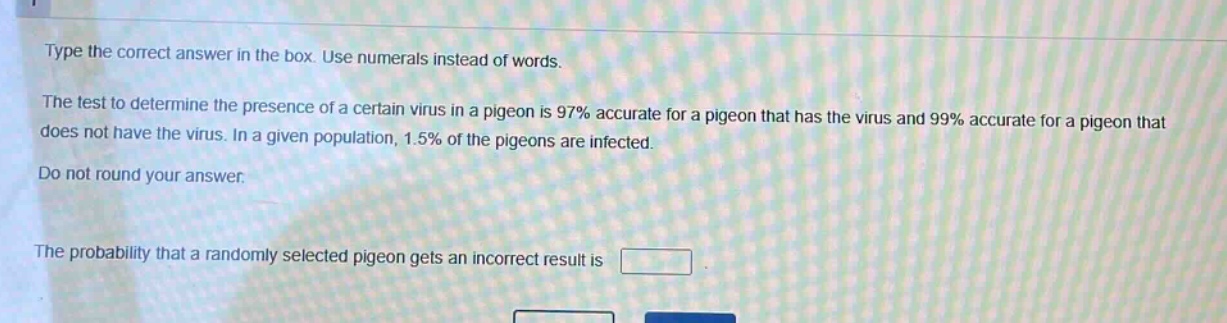
type the correct answer in the box. use numerals instead of words.\nthe test to determine the presence of a certain virus in a pigeon is 97% accurate for a pigeon that has the virus and 99% accurate for a pigeon that does not have the virus. in a given population, 1.5% of the pigeons are infected.\ndo not round your answer.\nthe probability that a randomly selected pigeon gets an incorrect result is
Answer
Explanation:
Step1: Calculate probability of false - positive
The proportion of non - infected pigeons is $1 - 0.015=0.985$. The test is $99%$ accurate for non - infected pigeons, so the probability of a false - positive (a non - infected pigeon testing positive) is $0.985\times(1 - 0.99)=0.985\times0.01$.
Step2: Calculate probability of false - negative
The proportion of infected pigeons is $0.015$. The test is $97%$ accurate for infected pigeons, so the probability of a false - negative (an infected pigeon testing negative) is $0.015\times(1 - 0.97)=0.015\times0.03$.
Step3: Calculate total probability of incorrect result
The probability of an incorrect result is the sum of the probability of false - positive and false - negative. So $P=(0.985\times0.01)+(0.015\times0.03)$. $P = 0.985\times0.01+0.015\times0.03=0.00985 + 0.00045=0.0103$.
Answer:
$0.0103$