type the correct answer in the box. use numerals instead of words. use / for the fraction bar. a cooler…
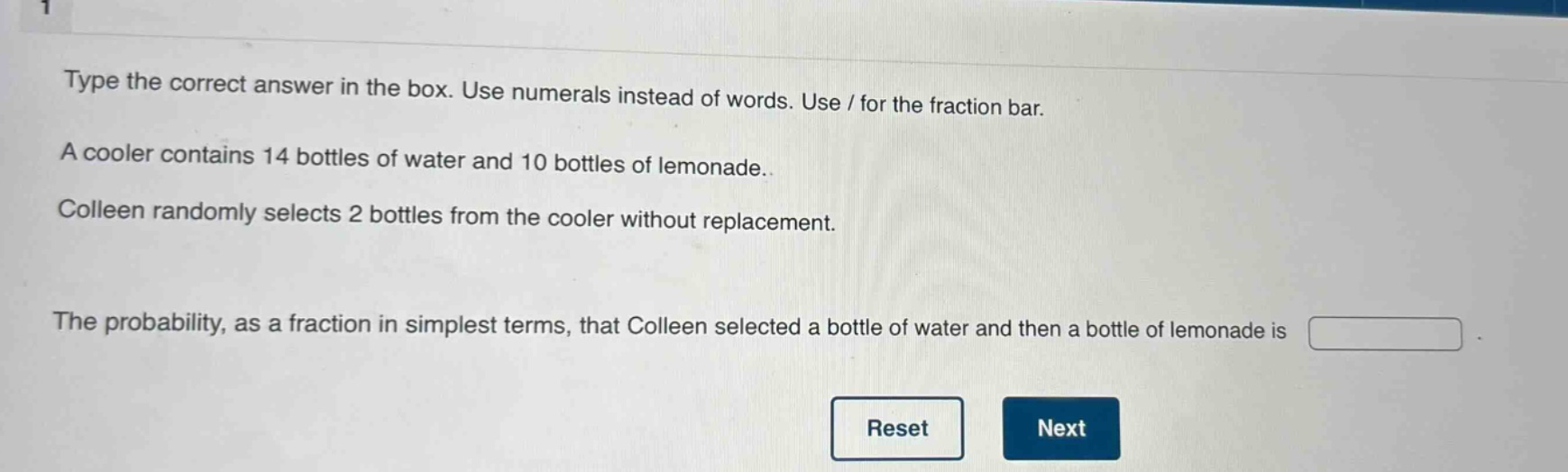
type the correct answer in the box. use numerals instead of words. use / for the fraction bar. a cooler contains 14 bottles of water and 10 bottles of lemonade. colleen randomly selects 2 bottles from the cooler without replacement. the probability, as a fraction in simplest terms, that colleen selected a bottle of water and then a bottle of lemonade is
Answer
Explanation:
Step1: Calculate total number of bottles
The total number of bottles initially is (14 + 10=24).
Step2: Calculate probability of first - selecting a water bottle
The probability of selecting a water bottle first is (\frac{14}{24}) since there are 14 water bottles out of 24 total bottles.
Step3: Calculate probability of second - selecting a lemonade bottle
After selecting a water bottle, there are (24 - 1=23) bottles left. And there are 10 lemonade bottles. So the probability of selecting a lemonade bottle second is (\frac{10}{23}).
Step4: Calculate the combined probability
Since these are dependent events, the probability of selecting a water bottle first and then a lemonade bottle is the product of the two probabilities. So (P=\frac{14}{24}\times\frac{10}{23}=\frac{14\times10}{24\times23}=\frac{140}{552}=\frac{35}{138}).
Answer:
(\frac{35}{138})