type the correct answer in the box. write your answer as a fraction, using / for the fraction bar. cathy has…
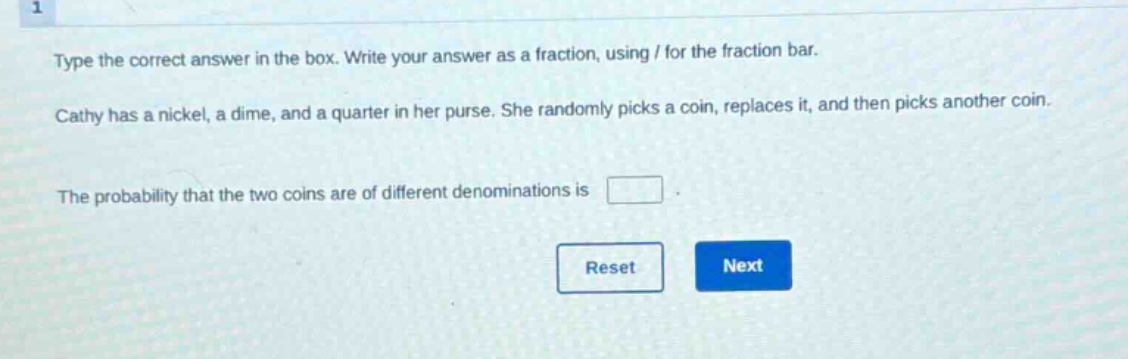
type the correct answer in the box. write your answer as a fraction, using / for the fraction bar. cathy has a nickel, a dime, and a quarter in her purse. she randomly picks a coin, replaces it, and then picks another coin. the probability that the two coins are of different denominations is
Answer
Explanation:
Step1: Calculate total number of outcomes
Since there are 3 coins and she picks with replacement, the total number of outcomes for two - coin picks is $3\times3 = 9$ (by the multiplication principle, as for the first pick there are 3 choices and for the second pick there are also 3 choices).
Step2: Calculate number of same - denomination outcomes
The cases where the two coins have the same denomination are (nickel, nickel), (dime, dime), (quarter, quarter), so there are 3 such cases.
Step3: Calculate number of different - denomination outcomes
The number of outcomes where the two coins have different denominations is the total number of outcomes minus the number of same - denomination outcomes. So it is $9 - 3=6$.
Step4: Calculate the probability
The probability $P$ that the two coins are of different denominations is the number of different - denomination outcomes divided by the total number of outcomes. So $P=\frac{6}{9}=\frac{2}{3}$.
Answer:
$\frac{2}{3}$