type your response in the box. tyson has two movie tickets and wants to randomly select one of six friends…
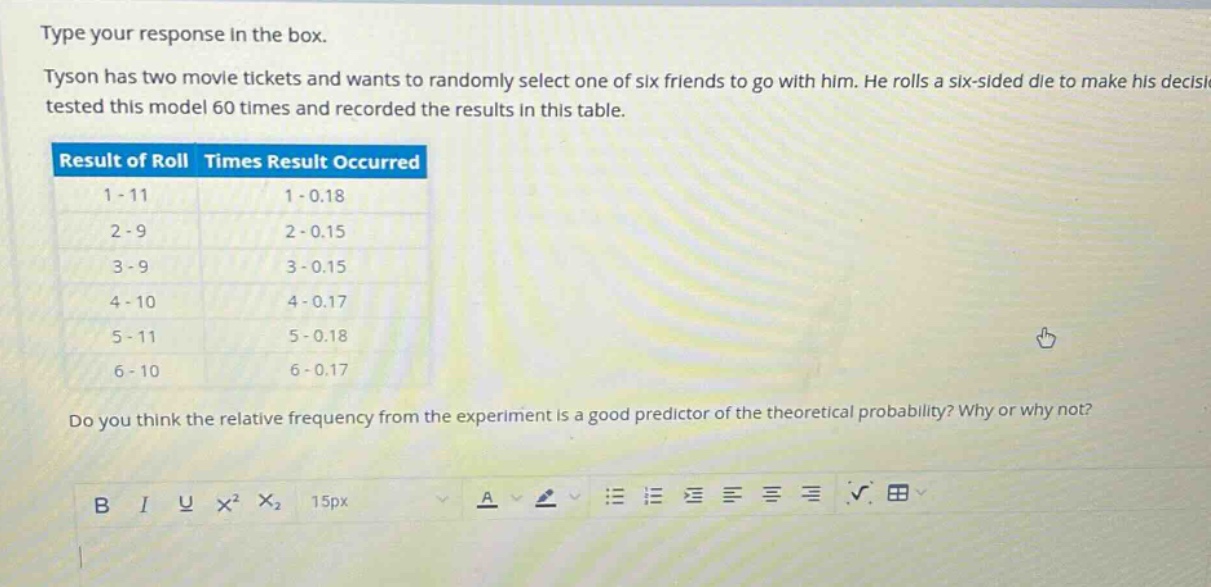
type your response in the box. tyson has two movie tickets and wants to randomly select one of six friends to go with him. he rolls a six - sided die to make his decision. he tested this model 60 times and recorded the results in this table. result of roll times result occurred 1 - 11 1 - 0.18 2 - 9 2 - 0.15 3 - 9 3 - 0.15 4 - 10 4 - 0.17 5 - 11 5 - 0.18 6 - 10 6 - 0.17 do you think the relative frequency from the experiment is a good predictor of the theoretical probability? why or why not?
Answer
Brief Explanations:
The theoretical probability of rolling any number on a fair six - sided die is $\frac{1}{6}\approx0.167$. The relative frequencies in the experiment (ranging from 0.15 to 0.18) are close to the theoretical probability. As the number of trials (60 in this case) is reasonably large, according to the law of large numbers, the relative frequency should approach the theoretical probability.
Answer:
Yes, because the relative frequencies are close to the theoretical probability of $\frac{1}{6}\approx0.167$ and the number of trials is reasonably large.