types of governments and economics\n1. how does direct democracy work?\n2. what is a republic (indirect…
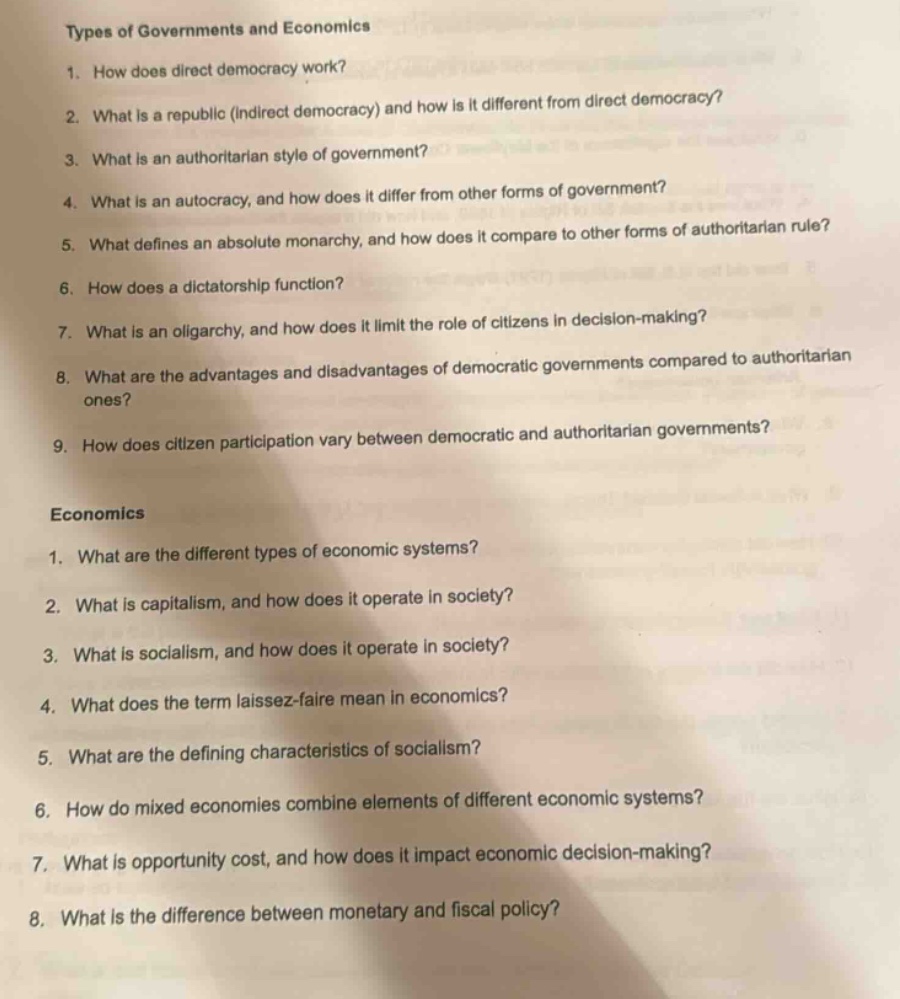
types of governments and economics\n1. how does direct democracy work?\n2. what is a republic (indirect democracy) and how is it different from direct democracy?\n3. what is an authoritarian style of government?\n4. what is an autocracy, and how does it differ from other forms of government?\n5. what defines an absolute monarchy, and how does it compare to other forms of authoritarian rule?\n6. how does a dictatorship function?\n7. what is an oligarchy, and how does it limit the role of citizens in decision - making?\n8. what are the advantages and disadvantages of democratic governments compared to authoritarian ones?\n9. how does citizen participation vary between democratic and authoritarian governments?\neconomics\n1. what are the different types of economic systems?\n2. what is capitalism, and how does it operate in society?\n3. what is socialism, and how does it operate in society?\n4. what does the term laissez - faire mean in economics?\n5. what are the defining characteristics of socialism?\n6. how do mixed economies combine elements of different economic systems?\n7. what is opportunity cost, and how does it impact economic decision - making?\n8. what is the difference between monetary and fiscal policy?
Answer
Brief Explanations:
- In direct democracy, citizens directly vote on laws and policies.
- A republic is a form where citizens elect representatives; in direct - democracy, there are no intermediaries.
- An authoritarian style of government has concentrated power, limiting civil liberties.
- An autocracy is rule by one person with absolute power, different from systems with power - sharing.
- An absolute monarchy is a type of autocracy where a monarch has unrestricted power.
- A dictatorship functions with one person or a small group having total control.
- An oligarchy is rule by a few, limiting citizen participation in decision - making.
- Democratic governments offer more freedoms but can be slower in decision - making; authoritarian ones can be more efficient but restrict rights.
- In democratic governments, citizens have more ways to participate; in authoritarian ones, participation is limited.
For economics:
- Types include market, command, and mixed economies.
- Capitalism is an economic system based on private ownership and profit - seeking.
- Socialism emphasizes collective or state ownership of the means of production.
- Laissez - faire means minimal government intervention in the economy.
- Socialism's characteristics include collective ownership and planned economy elements.
- Mixed economies combine elements of capitalism (private ownership) and socialism (state intervention).
- Opportunity cost is the value of the next best alternative; it affects economic choices.
- Monetary policy deals with money supply and interest rates; fiscal policy is about government spending and taxation.
Answer:
- In direct democracy, citizens directly vote on laws and policies.
- A republic is a form of government where citizens elect representatives to make decisions on their behalf. It differs from direct democracy in that in a republic, there are intermediaries (representatives), while in direct democracy, citizens participate directly without such intermediaries.
- An authoritarian style of government is one where power is concentrated in the hands of a single leader or a small group, often limiting civil liberties and political freedoms.
- An autocracy is a system of government in which a single individual holds absolute power. It differs from other forms of government as it lacks power - sharing mechanisms and checks - and - balances.
- An absolute monarchy is defined by a monarch having unrestricted power. Compared to other forms of authoritarian rule, it is based on hereditary succession and often has a more traditional and ceremonial aspect.
- A dictatorship functions with a single dictator or a small group in complete control, often suppressing opposition and making decisions unilaterally.
- An oligarchy is a form of government ruled by a few people. It limits the role of citizens in decision - making as the few in power make most of the important decisions without significant input from the general populace.
- Advantages of democratic governments include protection of civil liberties, representation of diverse interests, and peaceful transfer of power. Disadvantages can be slow decision - making and potential for political gridlock. Authoritarian governments can be more efficient in decision - making but often at the cost of civil rights and freedoms.
- In democratic governments, citizens can participate through voting, lobbying, protests, and running for office. In authoritarian governments, citizen participation is often limited to approved activities and there is little room for opposition or independent action.
For economics:
- Different types of economic systems include market economies (where supply and demand drive production and distribution), command economies (where the state controls production and distribution), and mixed economies (a combination of the two).
- Capitalism is an economic system based on private ownership of the means of production, free - market competition, and the pursuit of profit. In society, it encourages innovation, entrepreneurship, and individual economic freedom.
- Socialism is an economic system that emphasizes collective or state ownership of the means of production, with the aim of achieving greater equality and social welfare. In society, it often involves government - run enterprises and social safety nets.
- In economics, laissez - faire means a hands - off approach by the government, allowing the market to operate freely with minimal regulation.
- The defining characteristics of socialism include collective or state ownership of key industries, central planning of the economy to some extent, and a focus on social welfare and equality.
- Mixed economies combine elements of different economic systems by having both private - owned businesses operating in a free - market environment and government intervention in areas such as social welfare, infrastructure, and regulation.
- Opportunity cost is the value of the next best alternative that is forgone when a decision is made. It impacts economic decision - making as individuals and businesses must consider the trade - offs between different choices.
- Monetary policy is conducted by a central bank and involves controlling the money supply and interest rates to influence economic activity. Fiscal policy is implemented by the government and involves decisions about government spending and taxation to achieve economic goals.