uniform and non - uniform probability\nwhich spinner represents a uniform probability model?\na spinner a\nb…
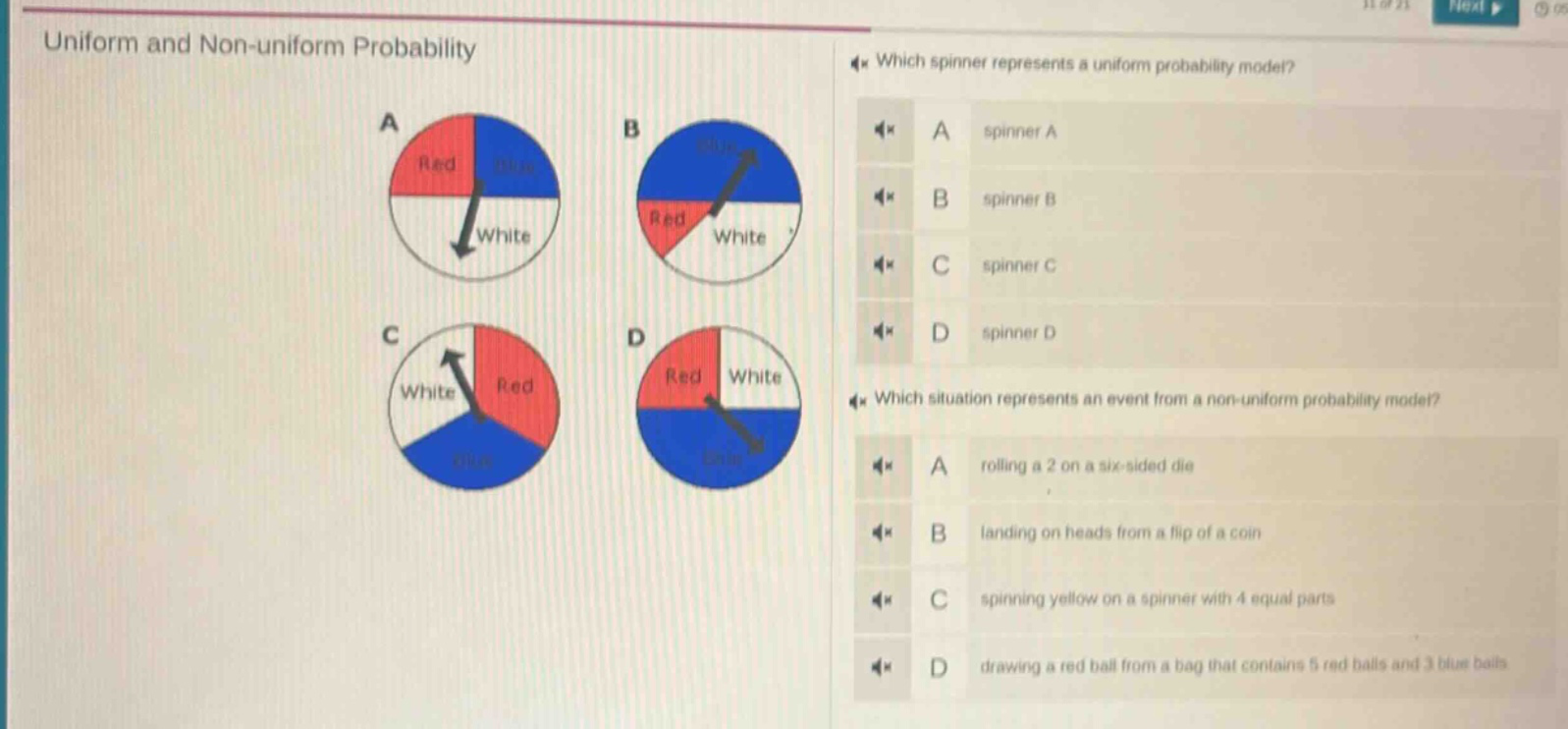
uniform and non - uniform probability\nwhich spinner represents a uniform probability model?\na spinner a\nb spinner b\nc spinner c\nd spinner d\nwhich situation represents an event from a non - uniform probability model?\na rolling a 2 on a six - sided die\nb landing on heads from a flip of a coin\nc spinning yellow on a spinner with 4 equal parts\nd drawing a red ball from a bag that contains 5 red balls and 3 blue balls
Answer
Answer:
- A. spinner A
- D. drawing a red ball from a bag that contains 5 red balls and 3 blue balls
Explanation:
Step1: Define uniform probability
In a uniform - probability model, all outcomes are equally likely. Spinner A has three equal - sized sections (red, blue, white), so each outcome has a probability of $\frac{1}{3}$.
Step2: Analyze non - uniform probability
For non - uniform probability, outcomes are not equally likely. In option D, the probability of drawing a red ball from a bag with 5 red balls and 3 blue balls is $\frac{5}{5 + 3}=\frac{5}{8}$, and the probability of drawing a blue ball is $\frac{3}{5+3}=\frac{3}{8}$. The probabilities are not equal, so it is a non - uniform probability model. Options A, B, and C represent uniform probability models (rolling a die, flipping a coin, and spinning a spinner with equal parts respectively).