“unknown cultural affiliations and loss of identity at high elevations.” these are words used to propose the…
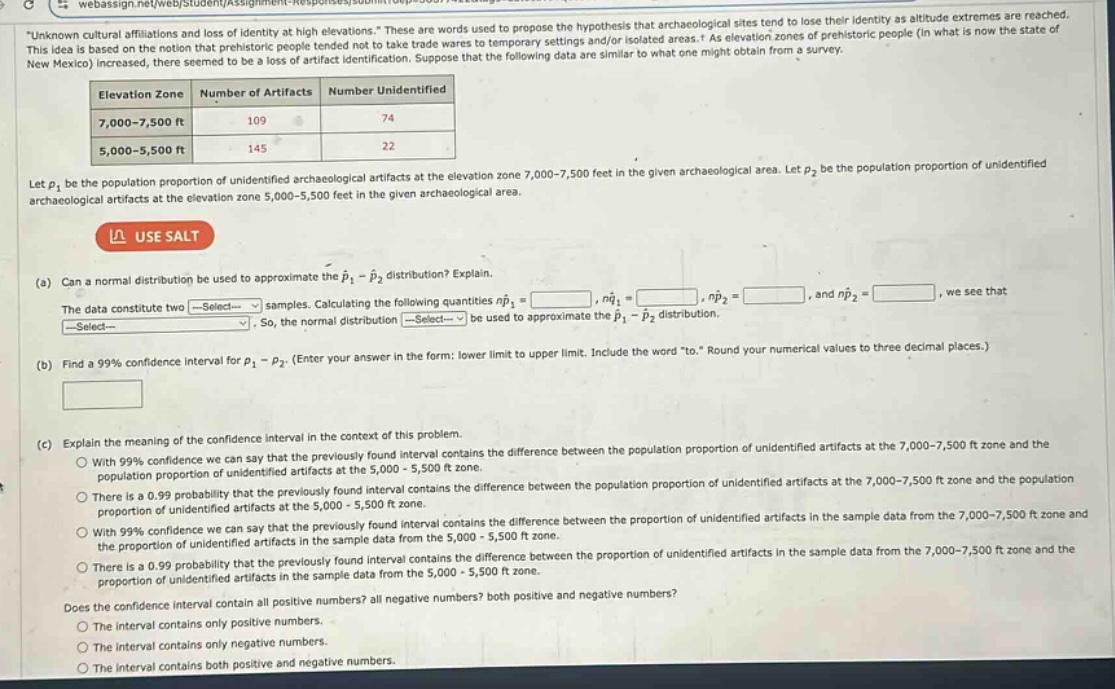
“unknown cultural affiliations and loss of identity at high elevations.” these are words used to propose the hypothesis that archaeological sites tend to lose their identity as altitude extremes are reached. this idea is based on the notion that prehistoric people tended not to take trade wares to temporary settings and/or isolated areas. as elevation zones of prehistoric people (in what is now the state of new mexico) increased, there seemed to be a loss of artifact identification. suppose that the following data are similar to what one might obtain from a survey. elevation zone number of artifacts number unidentified 7,000 - 7,500 ft 109 74 5,000 - 5,500 ft 145 22 let p1 be the population proportion of unidentified archaeological artifacts at the elevation zone 7,000 - 7,500 feet in the given archaeological area. let p2 be the population proportion of unidentified archaeological artifacts at the elevation zone 5,000 - 5,500 feet in the given archaeological area. use salt (a) can a normal distribution be used to approximate the p̂1 - p̂2 distribution? explain. the data constitute two - select - samples. calculating the following quantities np̂1 =, nq̂1 =, np̂2 =, and nq̂2 =, we see that - select - so, the normal distribution - select - be used to approximate the p̂1 - p̂2 distribution. (b) find a 99% confidence interval for p1 - p2. (enter your answer in the form: lower limit to upper limit. include the word “to.” round your numerical values to three decimal places.) (c) explain the meaning of the confidence interval in the context of this problem. with 99% confidence we can say that the previously found interval contains the difference between the population proportion of unidentified artifacts at the 7,000 - 7,500 ft zone and the population proportion of unidentified artifacts at the 5,000 - 5,500 ft zone. there is a 0.99 probability that the previously found interval contains the difference between the population proportion of unidentified artifacts at the 7,000 - 7,500 ft zone and the population proportion of unidentified artifacts at the 5,000 - 5,500 ft zone. with 99% confidence we can say that the previously found interval contains the difference between the proportion of unidentified artifacts in the sample data from the 7,000 - 7,500 ft zone and the proportion of unidentified artifacts in the sample data from the 5,000 - 5,500 ft zone. there is a 0.99 probability that the previously found interval contains the difference between the proportion of unidentified artifacts in the sample data from the 7,000 - 7,500 ft zone and the proportion of unidentified artifacts in the sample data from the 5,000 - 5,500 ft zone. does the confidence interval contain all positive numbers? all negative numbers? both positive and negative numbers? the interval contains only positive numbers. the interval contains only negative numbers. the interval contains both positive and negative numbers.
Answer
Explanation:
Step1: Calculate sample - proportions
For the 7000 - 7500 ft zone: $n_1 = 109$, $x_1=74$, so $\hat{p}_1=\frac{x_1}{n_1}=\frac{74}{109}\approx0.679$, $\hat{q}_1 = 1-\hat{p}_1=1 - 0.679 = 0.321$. For the 5000 - 5500 ft zone: $n_2 = 145$, $x_2 = 22$, so $\hat{p}_2=\frac{x_2}{n_2}=\frac{22}{145}\approx0.152$, $\hat{q}_2=1 - \hat{p}_2=1 - 0.152 = 0.848$.
Step2: Check normal - approximation conditions
$n_1\hat{p}_1=109\times0.679\approx74.011$, $n_1\hat{q}_1=109\times0.321\approx34.989$, $n_2\hat{p}_2=145\times0.152\approx22.04$, $n_2\hat{q}_2=145\times0.848\approx122.96$. Since $n_1\hat{p}_1\geq5$, $n_1\hat{q}_1\geq5$, $n_2\hat{p}_2\geq5$, and $n_2\hat{q}_2\geq5$, the normal distribution can be used to approximate the $\hat{p}_1-\hat{p}_2$ distribution.
Step3: Calculate the margin of error
The critical value $z_{\alpha/2}$ for a 99% confidence interval is $z_{0.005}=2.576$. The standard error $SE=\sqrt{\frac{\hat{p}_1\hat{q}_1}{n_1}+\frac{\hat{p}_2\hat{q}2}{n_2}}=\sqrt{\frac{0.679\times0.321}{109}+\frac{0.152\times0.848}{145}}\approx\sqrt{\frac{0.218}{109}+\frac{0.129}{145}}\approx\sqrt{0.002 + 0.0009}\approx\sqrt{0.0029}\approx0.054$. The margin of error $E = z{\alpha/2}\times SE=2.576\times0.054\approx0.139$.
Step4: Calculate the confidence interval
$\hat{p}_1-\hat{p}_2=0.679 - 0.152 = 0.527$. The 99% confidence interval is $(\hat{p}_1-\hat{p}_2)-E$ to $(\hat{p}_1-\hat{p}_2)+E$, which is $0.527-0.139$ to $0.527 + 0.139$, or $0.388$ to $0.666$.
Step5: Interpret the confidence interval
With 99% confidence we can say that the previously found interval contains the difference between the population proportion of unidentified artifacts at the 7000 - 7500 ft zone and the population proportion of unidentified artifacts at the 5000 - 5500 ft zone. The interval contains only positive numbers.
Answer:
(a) The data constitute two independent samples. Calculating the following quantities $n_1\hat{p}_1 = 74.011$, $n_1\hat{q}_1=34.989$, $n_2\hat{p}_2 = 22.04$, and $n_2\hat{q}_2=122.96$, we see that $n_1\hat{p}_1\geq5$, $n_1\hat{q}_1\geq5$, $n_2\hat{p}_2\geq5$, $n_2\hat{q}_2\geq5$. So, the normal distribution can be used to approximate the $\hat{p}_1-\hat{p}_2$ distribution. (b) 0.388 to 0.666 (c) With 99% confidence we can say that the previously found interval contains the difference between the population proportion of unidentified artifacts at the 7000 - 7500 ft zone and the population proportion of unidentified artifacts at the 5000 - 5500 ft zone. The interval contains only positive numbers.