use the counting principle to find the number of outcomes.\n4. runners in a marathon are randomly assigned…
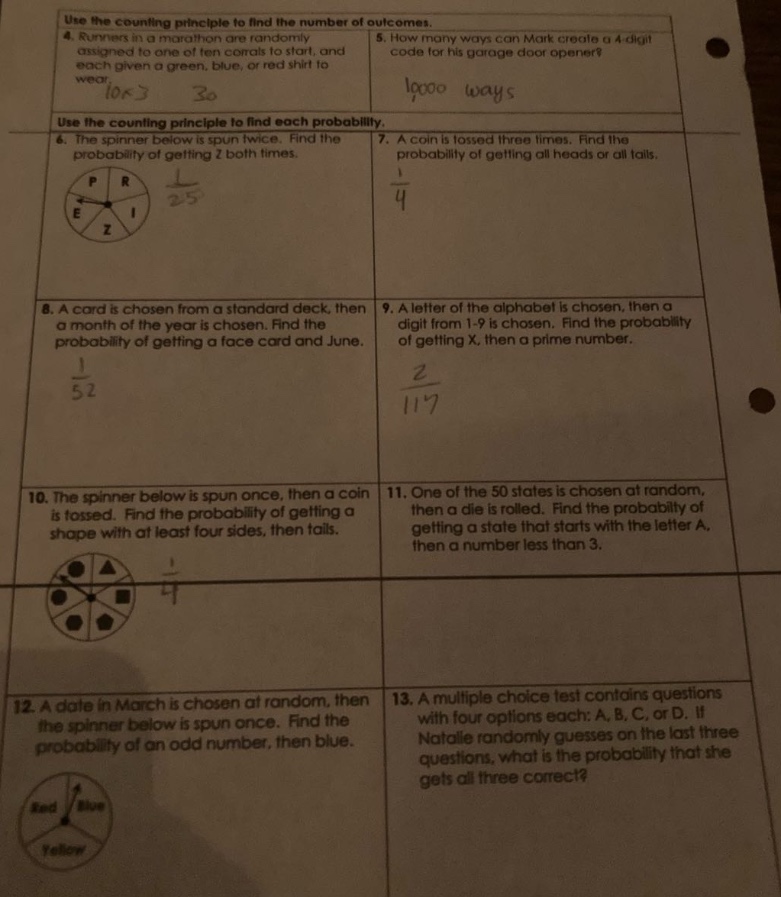
use the counting principle to find the number of outcomes.\n4. runners in a marathon are randomly assigned to one of ten corrals to start, and each given a green, blue, or red shirt to wear.\n5. how many ways can mark create a 4 - digit code for his garage door opener?\nuse the counting principle to find each probability.\n6. the spinner below is spun twice. find the probability of getting z both times.\n7. a coin is tossed three times. find the probability of getting all heads or all tails.\n8. a card is chosen from a standard deck, then a month of the year is chosen. find the probability of getting a face card and june.\n9. a letter of the alphabet is chosen, then a digit from 1 - 9 is chosen. find the probability of getting x, then a prime number.\n10. the spinner below is spun once, then a coin is tossed. find the probability of getting a shape with at least four sides, then tails.\n11. one of the 50 states is chosen at random, then a die is rolled. find the probability of getting a state that starts with the letter a, then a number less than 3.\n12. a date in march is chosen at random, then the spinner below is spun once. find the probability of an odd number, then blue.\n13. a multiple - choice test contains questions with four options each: a, b, c, or d. if natalie randomly guesses on the last three questions, what is the probability that she gets all three correct?
Answer
Explanation:
Step1: Recall counting - principle
The counting principle states that if there are (m) ways to do one thing and (n) ways to do another thing, then there are (m\times n) ways to do both things. Probability (P(A)=\frac{\text{Number of favorable outcomes}}{\text{Total number of outcomes}}).
Step6:
The spinner has 5 sections. The total number of outcomes when spun twice is (n = 5\times5=25) (by the counting - principle). The favorable outcome (getting Z both times) is 1. So the probability (P=\frac{1}{25}).
Step7:
When a coin is tossed, there are 2 possible outcomes (head or tail). When tossed 3 times, the total number of outcomes is (n = 2\times2\times2=8) (by the counting - principle). The favorable outcomes (all heads or all tails) are 2. So the probability (P=\frac{2}{8}=\frac{1}{4}).
Step8:
A standard deck has 52 cards, and there are 12 face - cards. The probability of choosing a face - card is (\frac{12}{52}). There are 12 months in a year, and the probability of choosing June is (\frac{1}{12}). By the counting - principle, the total number of combined outcomes is (52\times12), and the number of favorable outcomes is (12\times1). So the probability (P=\frac{12\times1}{52\times12}=\frac{1}{52}).
Step9:
There are 26 letters in the alphabet. The probability of choosing X is (\frac{1}{26}). There are 9 digits from 1 - 9, and the prime numbers among them are 2, 3, 5, 7 (4 prime numbers). The probability of choosing a prime number is (\frac{4}{9}). By the counting - principle, the total number of combined outcomes is (26\times9), and the number of favorable outcomes is (1\times4). So the probability (P=\frac{1\times4}{26\times9}=\frac{2}{117}).
Step10:
The spinner has 8 sections. Shapes with at least four sides are 4 (the square - like shapes). The probability of getting a shape with at least four sides is (\frac{4}{8}). When a coin is tossed, the probability of getting tails is (\frac{1}{2}). By the counting - principle, the total number of combined outcomes is (8\times2), and the number of favorable outcomes is (4\times1). So the probability (P=\frac{4\times1}{8\times2}=\frac{1}{4}).
Step11:
There are 50 states. 4 states start with the letter A (Alabama, Alaska, Arizona, Arkansas). The probability of choosing a state starting with A is (\frac{4}{50}). A die has 6 sides, and the numbers less than 3 are 1 and 2. The probability of getting a number less than 3 on a die is (\frac{2}{6}). By the counting - principle, the total number of combined outcomes is (50\times6), and the number of favorable outcomes is (4\times2). So the probability (P=\frac{4\times2}{50\times6}=\frac{4}{150}=\frac{2}{75}).
Step12:
March has 31 days. The odd - numbered days are 16. The probability of choosing an odd - numbered day in March is (\frac{16}{31}). The spinner has 3 sections, and the probability of getting blue is (\frac{1}{3}). By the counting - principle, the total number of combined outcomes is (31\times3), and the number of favorable outcomes is (16\times1). So the probability (P=\frac{16\times1}{31\times3}=\frac{16}{93}).
Step13:
Each multiple - choice question has 4 options. The probability of getting one question correct by guessing is (\frac{1}{4}). For 3 independent questions, by the counting - principle, the total number of outcomes for the 3 questions is (4\times4\times4 = 64), and the number of favorable outcomes (getting all 3 correct) is 1. So the probability (P=\frac{1}{4\times4\times4}=\frac{1}{64}).
Answer:
- (\frac{1}{25})
- (\frac{1}{4})
- (\frac{1}{52})
- (\frac{2}{117})
- (\frac{1}{4})
- (\frac{2}{75})
- (\frac{16}{93})
- (\frac{1}{64})