use the following formula for calculating binomial probabilities to answer the question.\n$_{n}c_{k}(p)^{k}(1…
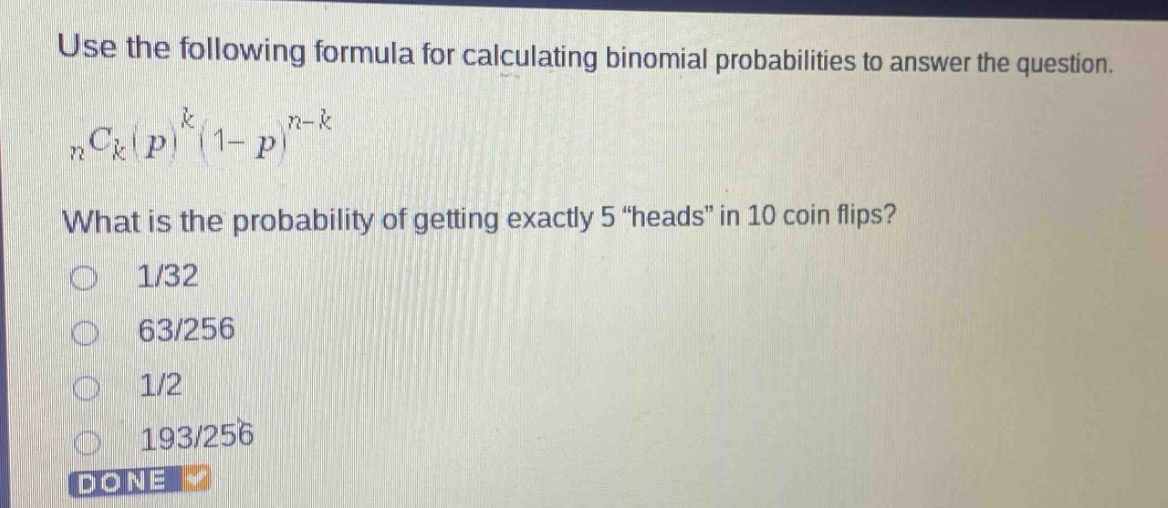
use the following formula for calculating binomial probabilities to answer the question.\n$_{n}c_{k}(p)^{k}(1 - p)^{n - k}$\nwhat is the probability of getting exactly 5 \heads\ in 10 coin flips?\n1/32\n63/256\n1/2\n193/256\ndone
Answer
Explanation:
Step1: Identify values of n, k, p
$n = 10$ (number of coin - flips), $k = 5$ (number of heads), $p=\frac{1}{2}$ (probability of getting a head in a single coin - flip).
Step2: Calculate combination ${n}C{k}$
${n}C{k}=\frac{n!}{k!(n - k)!}$, so ${10}C{5}=\frac{10!}{5!(10 - 5)!}=\frac{10!}{5!5!}=\frac{10\times9\times8\times7\times6}{5\times4\times3\times2\times1}=252$.
Step3: Calculate binomial probability
The binomial - probability formula is ${n}C{k}(p)^{k}(1 - p)^{n - k}$. Substitute $n = 10$, $k = 5$, $p=\frac{1}{2}$ into the formula: ${10}C{5}(\frac{1}{2})^{5}(1-\frac{1}{2})^{10 - 5}=252\times(\frac{1}{2})^{5}\times(\frac{1}{2})^{5}=252\times\frac{1}{32}\times\frac{1}{32}=\frac{252}{1024}=\frac{63}{256}$.
Answer:
63/256