use the information to answer the question. mr. williams has a bag filled with 3 red pencils and 12 blue…
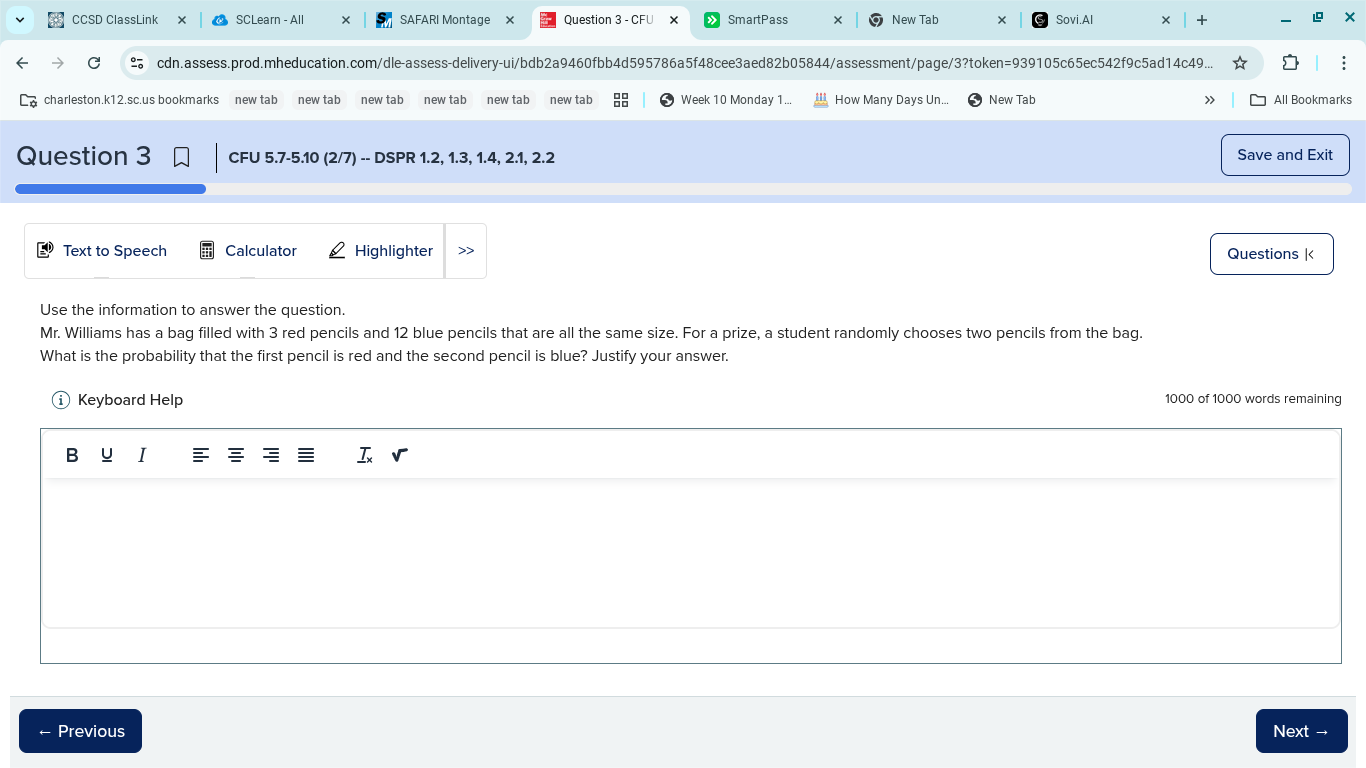
use the information to answer the question. mr. williams has a bag filled with 3 red pencils and 12 blue pencils that are all the same size. for a prize, a student randomly chooses two pencils from the bag. what is the probability that the first pencil is red and the second pencil is blue? justify your answer.
Answer
Explanation:
Step1: Find total number of pencils
First, calculate the total number of pencils. There are 3 red and 12 blue, so total is (3 + 12 = 15) pencils.
Step2: Probability first is red
The probability that the first pencil is red is the number of red pencils divided by total pencils. So (P(\text{first red})=\frac{3}{15}=\frac{1}{5}).
Step3: Probability second is blue (after first red)
After removing one red pencil, there are (15 - 1 = 14) pencils left, and 12 blue pencils. So (P(\text{second blue}|\text{first red})=\frac{12}{14}=\frac{6}{7}).
Step4: Multiply the probabilities
Since these are dependent events, multiply the two probabilities: (P=\frac{1}{5}\times\frac{6}{7}=\frac{6}{35}).
To justify: We use the multiplication rule for dependent events. The first event (choosing red) affects the second event (choosing blue) because the total number of pencils decreases by 1 after the first pick. So we calculate the probability of the first event, then the probability of the second event given the first occurred, and multiply them.
Answer:
The probability is (\frac{6}{35}). The justification is that we calculate the probability of choosing a red pencil first ((\frac{3}{15})) and then a blue pencil from the remaining 14 pencils ((\frac{12}{14})), then multiply these probabilities for dependent events, resulting in (\frac{3}{15}\times\frac{12}{14}=\frac{6}{35}).