use the results from a survey of a simple random sample of 1260 adults. among the 1260 respondents, 67%…
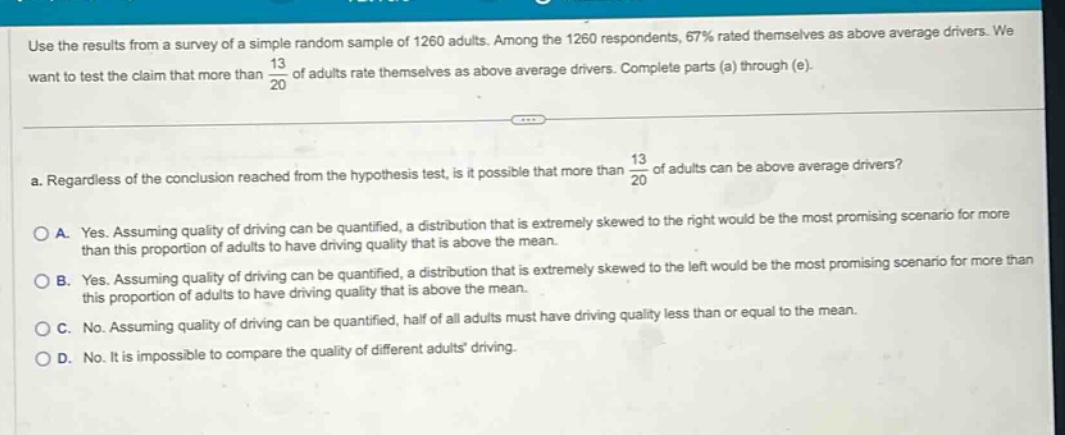
use the results from a survey of a simple random sample of 1260 adults. among the 1260 respondents, 67% rated themselves as above - average drivers. we want to test the claim that more than $\frac{13}{20}$ of adults rate themselves as above - average drivers. complete parts (a) through (e).\na. regardless of the conclusion reached from the hypothesis test, is it possible that more than $\frac{13}{20}$ of adults can be above - average drivers?\na. yes. assuming quality of driving can be quantified, a distribution that is extremely skewed to the right would be the most promising scenario for more than this proportion of adults to have driving quality that is above the mean.\nb. yes. assuming quality of driving can be quantified, a distribution that is extremely skewed to the left would be the most promising scenario for more than this proportion of adults to have driving quality that is above the mean.\nc. no. assuming quality of driving can be quantified, half of all adults must have driving quality less than or equal to the mean.\nd. no. it is impossible to compare the quality of different adults driving.
Answer
Brief Explanations:
If the quality of driving can be quantified, in a left - skewed distribution, the mean is pulled towards the tail on the left side. So, a large proportion of the data can be above the mean. In this case, it is possible for more than $\frac{13}{20}=0.65$ of adults to rate themselves as above - average drivers.
Answer:
B. Yes. Assuming quality of driving can be quantified, a distribution that is extremely skewed to the left would be the most promising scenario for more than this proportion of adults to have driving quality that is above the mean.