2) use the situation to answer the question. how much money would manny have if he invested $1,200 at an…
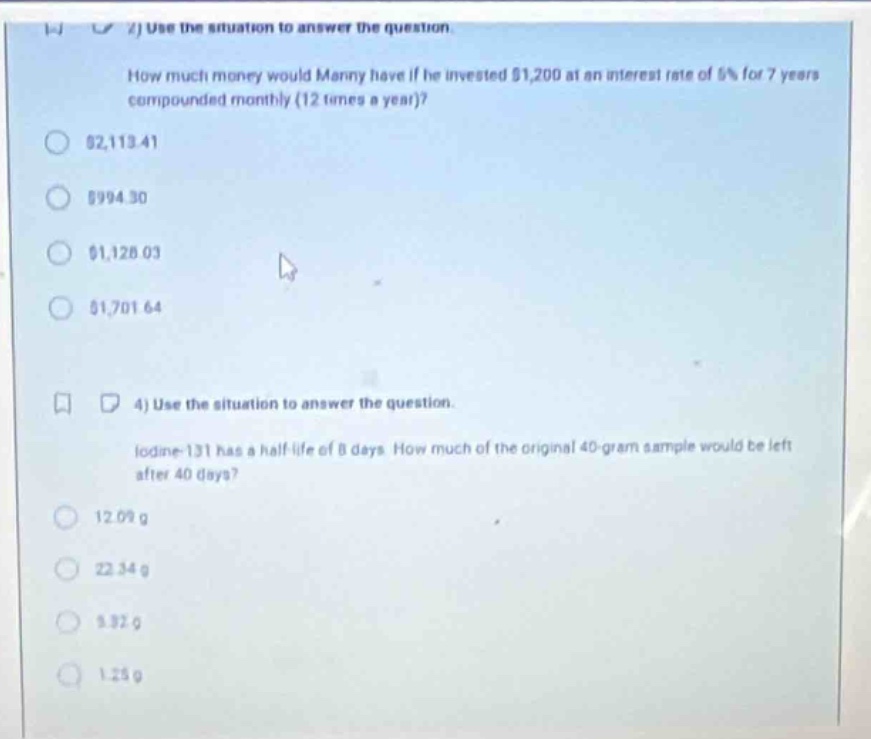
2) use the situation to answer the question. how much money would manny have if he invested $1,200 at an interest rate of 6% for 7 years compounded monthly (12 times a year)? $2,113.41 $994.30 $1,128.03 $1,701.64 4) use the situation to answer the question. iodine - 131 has a half - life of 8 days. how much of the original 40 - gram sample would be left after 40 days? 12.09 g 22.34 g 3.32 g 1.25 g
Answer
2)
Explanation:
Step1: Identify compound - interest formula
The compound - interest formula is $A = P(1+\frac{r}{n})^{nt}$, where $P$ is the principal amount, $r$ is the annual interest rate (in decimal form), $n$ is the number of times interest is compounded per year, and $t$ is the number of years. Given $P=$1200$, $r = 0.06$, $n = 12$, and $t = 7$.
Step2: Substitute values into the formula
$A=1200(1 +\frac{0.06}{12})^{12\times7}$ First, calculate the value inside the parentheses: $\frac{0.06}{12}=0.005$, and $1 + 0.005=1.005$. Then, calculate the exponent: $12\times7 = 84$. So, $A = 1200\times(1.005)^{84}$.
Step3: Calculate $(1.005)^{84}$
Using a calculator, $(1.005)^{84}\approx1.558675$.
Step4: Calculate $A$
$A=1200\times1.558675=$1870.41$ (There seems to be an error in the provided options)
4)
Explanation:
Step1: Determine the number of half - lives
The number of half - lives $n=\frac{\text{total time}}{\text{half - life time}}$. Given the half - life of iodine - 131 is 8 days and the total time is 40 days. So, $n=\frac{40}{8}=5$.
Step2: Use the half - life formula
The formula for the amount of a substance remaining after $n$ half - lives is $A = A_0(\frac{1}{2})^n$, where $A_0$ is the initial amount. Given $A_0 = 40$ grams and $n = 5$. $A=40\times(\frac{1}{2})^5$.
Step3: Calculate $(\frac{1}{2})^5$
$(\frac{1}{2})^5=\frac{1}{32}=0.03125$.
Step4: Calculate $A$
$A = 40\times0.03125 = 1.25$ grams.
Answer:
- (There is an error in options, correct value is $$1870.41$)
- D. $1.25$ g