use the spinner to determine the probability of the event. spinning an odd prime
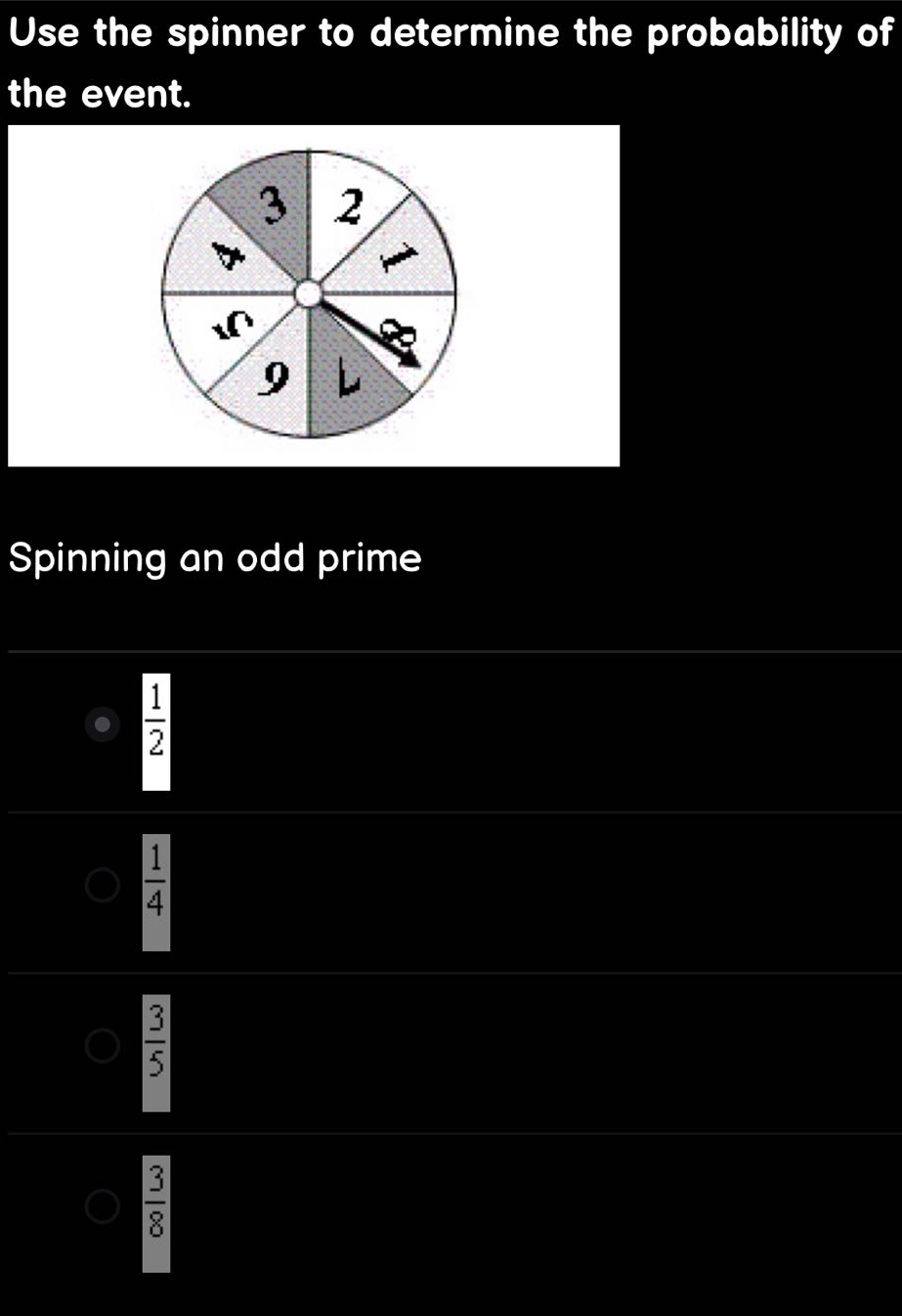
use the spinner to determine the probability of the event. spinning an odd prime
Answer
Explanation:
Step1: Determine the total number of outcomes
The spinner is divided into 8 equal - sized sections. So, the total number of possible outcomes ( n(S)=8 ).
Step2: Identify the odd - prime numbers on the spinner
Prime numbers are numbers greater than 1 that have only two distinct positive divisors: 1 and the number itself. The odd - prime numbers on the spinner are 3, 7. (1 is not a prime number as it has only one positive divisor, 2 is a prime number but it is even, 9 is not a prime number since (9 = 3\times3)). So, the number of favorable outcomes (n(E)=3) (if we consider the general formula for probability (P(E)=\frac{n(E)}{n(S)}), where (n(E)) is the number of elements in the event set and (n(S)) is the number of elements in the sample space).
The probability formula is (P(E)=\frac{n(E)}{n(S)}). Substituting (n(E) = 3) (odd - prime numbers: 3, 7) and (n(S)=8) into the formula, we get (P=\frac{3}{8}).
Answer:
(\frac{3}{8})