use the spinner shown. it is equally probable that the pointer will land on any one of the regions. if the…
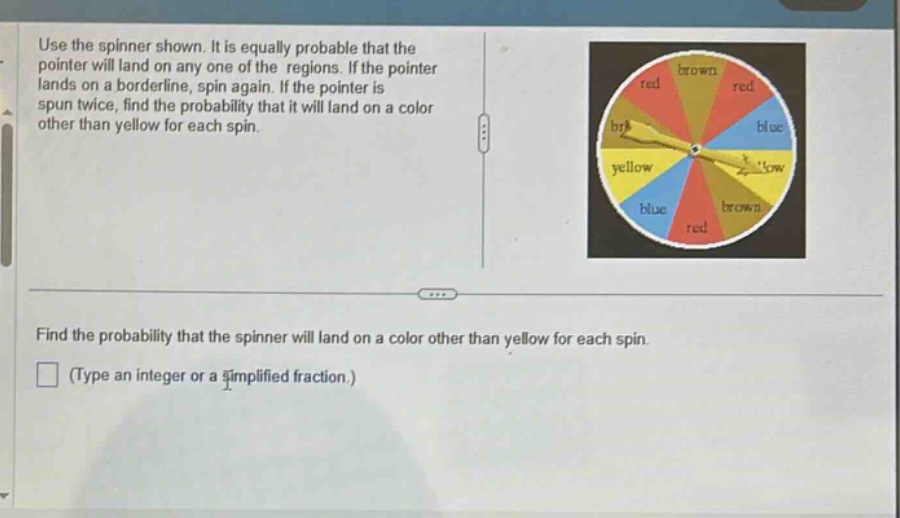
use the spinner shown. it is equally probable that the pointer will land on any one of the regions. if the pointer lands on a borderline, spin again. if the pointer is spun twice, find the probability that it will land on a color other than yellow for each spin. find the probability that the spinner will land on a color other than yellow for each spin. (type an integer or a simplified fraction.)
Answer
Explanation:
Step1: Count total and non - yellow regions
The spinner has 8 regions in total. There are 2 yellow regions, so the number of non - yellow regions is $8 - 2=6$.
Step2: Calculate probability of non - yellow on one spin
The probability of landing on a non - yellow region on one spin, $P(\text{non - yellow})$, is the number of non - yellow regions divided by the total number of regions. So $P(\text{non - yellow})=\frac{6}{8}=\frac{3}{4}$.
Step3: Calculate probability for two independent spins
Since the two spins are independent events, the probability that it lands on a non - yellow region for each spin is the product of the probabilities of landing on a non - yellow region in each individual spin. So $P = \frac{3}{4}\times\frac{3}{4}=\frac{9}{16}$.
Answer:
$\frac{9}{16}$