use the table to answer the question.\n| | arrival time |\n|--|--|--|--|--|\n| transport type | on time |…
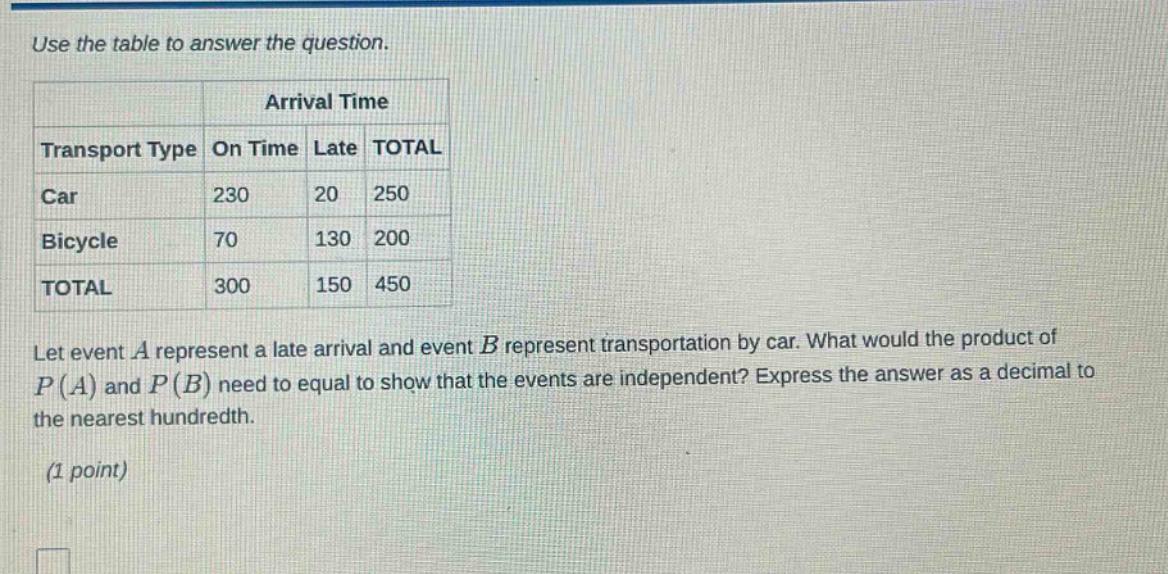
use the table to answer the question.\n| | arrival time |\n|--|--|--|--|--|\n| transport type | on time | late | total |\n| car | 230 | 20 | 250 |\n| bicycle | 70 | 130 | 200 |\n| total | 300 | 150 | 450 |\nlet event (a) represent a late arrival and event (b) represent transportation by car. what would the product of (p(a)) and (p(b)) need to equal to show that the events are independent? express the answer as a decimal to the nearest hundredth.\n(1 point)
Answer
Explanation:
Step1: Calculate P(A)
The probability of a late - arrival $P(A)$ is the number of late arrivals divided by the total number of arrivals. The number of late arrivals is 150 and the total number of arrivals is 450. So, $P(A)=\frac{150}{450}=\frac{1}{3}\approx0.33$.
Step2: Calculate P(B)
The probability of transportation by car $P(B)$ is the number of car arrivals divided by the total number of arrivals. The number of car arrivals is 250 and the total number of arrivals is 450. So, $P(B)=\frac{250}{450}=\frac{5}{9}\approx0.56$.
Step3: Calculate P(A)×P(B)
Multiply the two probabilities: $P(A)\times P(B)=\frac{1}{3}\times\frac{5}{9}=\frac{5}{27}\approx0.19$.
Answer:
0.19