use the typing tool to fill in the white boxes with the correct work and solution to each question. reduce…
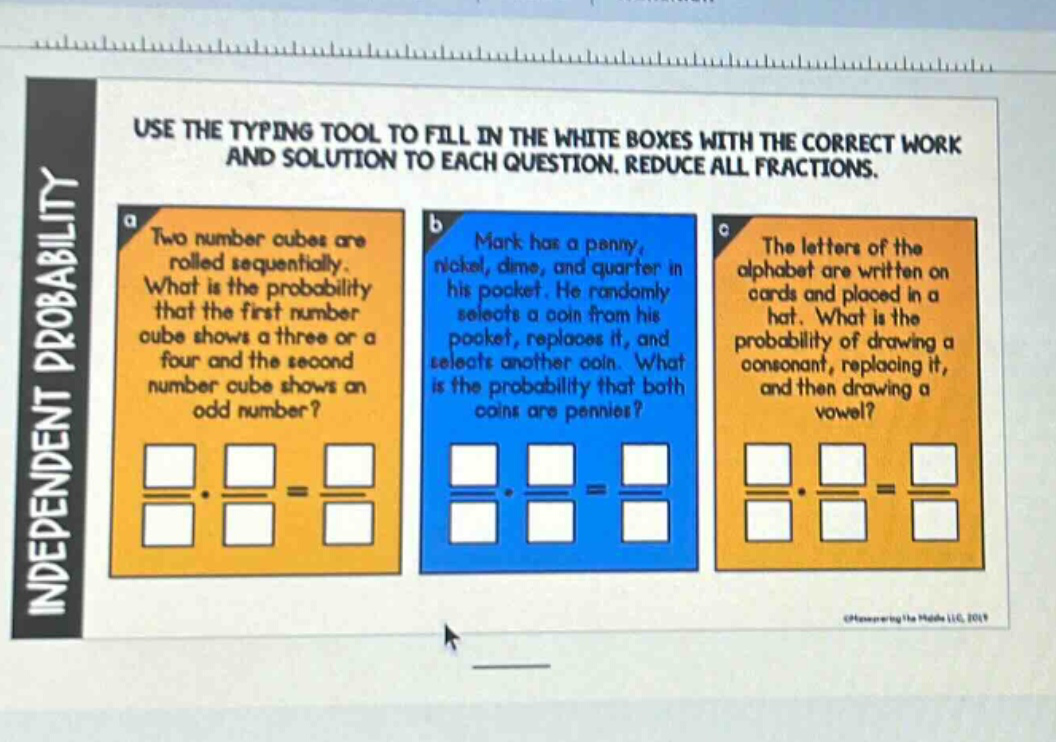
use the typing tool to fill in the white boxes with the correct work and solution to each question. reduce all fractions. a two number cubes are rolled sequentially. what is the probability that the first number cube shows a three or a four and the second number cube shows an odd number? b mark has a penny, nickel, dime, and quarter in his pocket. he randomly selects a coin from his pocket, replaces it, and selects another coin. what is the probability that both coins are pennies? c the letters of the alphabet are written on cards and placed in a hat. what is the probability of drawing a consonant, replacing it, and then drawing a vowel? independent probability
Answer
Explanation:
Step1: Calculate probability for first - cube in part a
A number cube has 6 faces. The event that the first number cube shows a 3 or a 4 has 2 favorable outcomes. So the probability $P_1=\frac{2}{6}=\frac{1}{3}$.
Step2: Calculate probability for second - cube in part a
The event that the second number cube shows an odd number (1, 3, 5) has 3 favorable outcomes. So the probability $P_2=\frac{3}{6}=\frac{1}{2}$.
Step3: Calculate combined probability for part a
Since the two events are independent, the probability of both events occurring is the product of their probabilities. $P_a = P_1\times P_2=\frac{1}{3}\times\frac{1}{2}=\frac{1}{6}$.
Step4: Calculate probability for first - coin selection in part b
Mark has 4 coins (penny, nickel, dime, quarter). The probability of selecting a penny on the first draw is $P_3=\frac{1}{4}$.
Step5: Calculate probability for second - coin selection in part b
Since the coin is replaced, the probability of selecting a penny on the second draw is also $P_4=\frac{1}{4}$.
Step6: Calculate combined probability for part b
Since the two draws are independent, the probability of both being pennies is $P_b=P_3\times P_4=\frac{1}{4}\times\frac{1}{4}=\frac{1}{16}$.
Step7: Calculate probability for drawing a consonant in part c
There are 26 letters in the alphabet, 21 consonants. So the probability of drawing a consonant is $P_5=\frac{21}{26}$.
Step8: Calculate probability for drawing a vowel in part c
There are 5 vowels in the alphabet. So the probability of drawing a vowel is $P_6=\frac{5}{26}$.
Step9: Calculate combined probability for part c
Since the two draws are independent, the probability is $P_c = P_5\times P_6=\frac{21}{26}\times\frac{5}{26}=\frac{105}{676}$.
Answer:
a. $\frac{1}{6}$ b. $\frac{1}{16}$ c. $\frac{105}{676}$