using the appropriate model, sample size $n$, and output below:\n\nmodel: $y = \\beta_0 + \\beta_1 x_1 +…
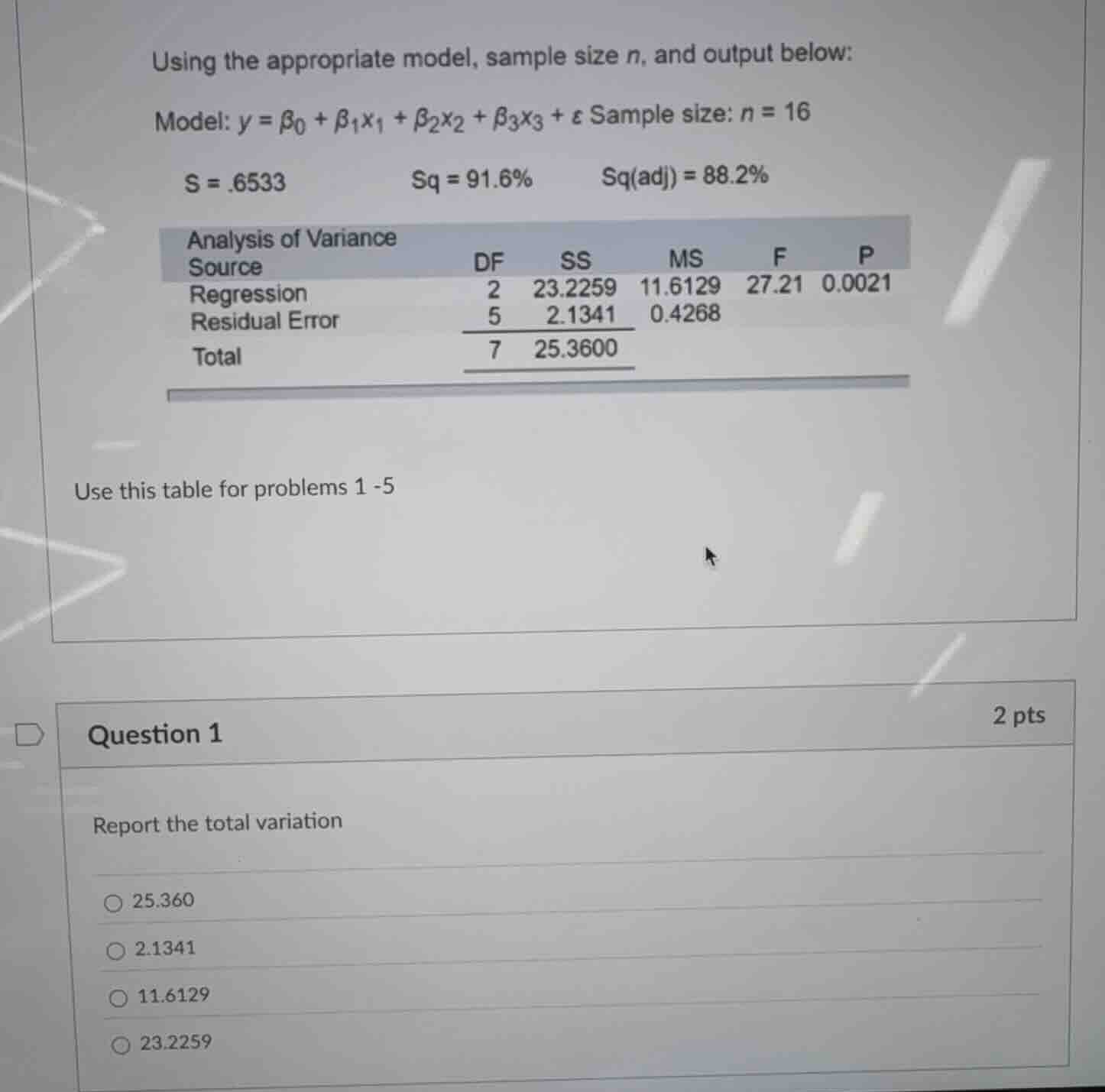
using the appropriate model, sample size $n$, and output below:\n\nmodel: $y = \\beta_0 + \\beta_1 x_1 + \\beta_2 x_2 + \\beta_3 x_3 + \\epsilon$ sample size: $n = 16$\n\n$s = .6533$ $sq = 91.6\\%$ $sq(adj) = 88.2\\%$\n\nanalysis of variance\nsource df ss ms f p\nregression 2 23.2259 11.6129 27.21 0.0021\nresidual error 5 2.1341 0.4268\ntotal 7 25.3600\n\nuse this table for problems 1 -5\n\nquestion 1\nreport the total variation\n\n25.360\n2.1341\n11.6129\n23.2259
Answer
Explanation:
Step1: Identify the term for total variation
In an Analysis of Variance (ANOVA) table, the "total variation" in the dependent variable is represented by the Total Sum of Squares ($SS_{Total}$).
Step2: Locate the value in the ANOVA table
Find the row labeled "Total" and the column labeled "SS" (Sum of Squares). The value at the intersection of this row and column is the total variation.
Step3: Extract the value
From the provided table, the Sum of Squares ($SS$) for the "Total" source is $25.3600$.
Answer:
25.360