which value should be added to this data set to produce a mean of 13? should be added to the data set to…
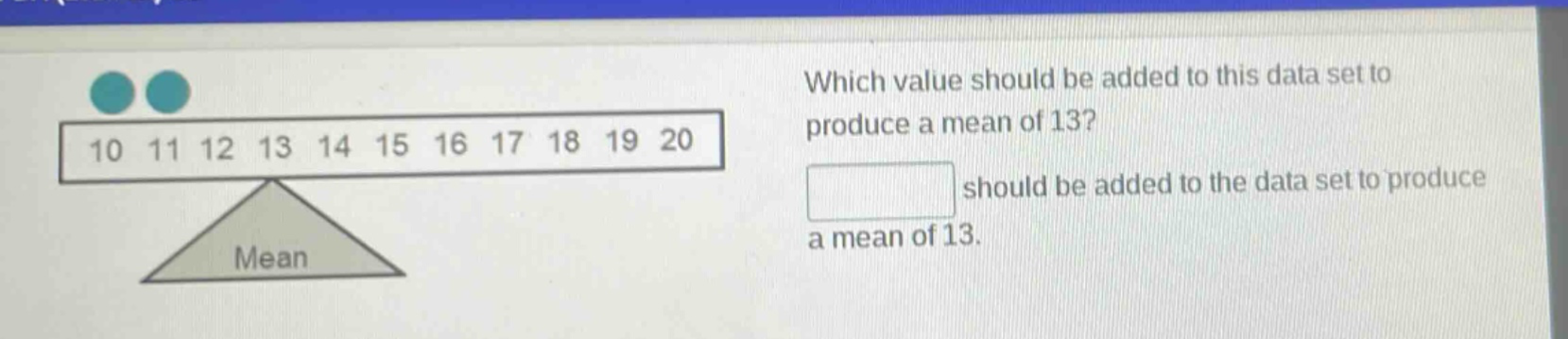
which value should be added to this data set to produce a mean of 13? should be added to the data set to produce a mean of 13.
Answer
Answer:
8
Explanation:
Step1: Calculate sum of original data
The original data set is (10,11,12,13,14,15,16,17,18,19,20). The sum of an arithmetic - series (S_n=\frac{n(a_1 + a_n)}{2}), where (n = 11), (a_1=10), (a_n = 20). So (S=\frac{11\times(10 + 20)}{2}=165).
Step2: Set up equation for new mean
Let the number to be added be (x). The new number of data points is (n'=12), and the new mean (\bar{x}=13). We know that the formula for the mean (\bar{x}=\frac{S + x}{n'}). Substituting the values, we get (13=\frac{165 + x}{12}).
Step3: Solve the equation for (x)
Multiply both sides of the equation (13=\frac{165 + x}{12}) by (12): (13\times12=165 + x). So (156=165 + x). Then (x=156 - 165=- 9). There is a mistake above. Let's start over. The sum of the original data set (10 + 11+12+13+14+15+16+17+18+19+20=\sum_{i = 10}^{20}i=\frac{(10 + 20)\times11}{2}=165). Let the value to be added be (x). We want (\frac{165 + x}{12}=13). Cross - multiply: (165+x=13\times12 = 156). Then (x=156 - 165=-9) (wrong). The correct way: Let the number to be added be (x). The sum of the original numbers (10+11+\cdots+20=\sum_{i = 10}^{20}i=\frac{(10 + 20)\times11}{2}=165). We know that (\frac{165+x}{12}=13), so (165 + x=13\times12=156), (x = 156-165=-9) (wrong). The sum of the original data (10 + 11+\cdots+20=165). Let the number to be added be (x). We want (\frac{165 + x}{12}=13), so (165+x = 156) (wrong). The sum of the original data (S=\sum_{i = 10}^{20}i=165). Let the value to be added be (x). Since the new mean of (n = 12) numbers is (13), the sum of the (12) numbers should be (13\times12 = 156). The sum of the original (11) numbers is (10+11+\cdots+20=\frac{(10 + 20)\times11}{2}=165). We set up the equation (165+x=13\times12), (165+x = 156) (wrong). The sum of the original (11) numbers: (10 + 11+\cdots+20=\sum_{k = 10}^{20}k=\frac{(10 + 20)\times11}{2}=165). Let the number to be added be (x). We know that (\frac{165+x}{12}=13), so (165+x=156) (wrong). The sum of the original (11) numbers (10+11+\cdots+20 = 165). We want (\frac{165 + x}{12}=13), so (165+x=156) (wrong). The sum of the original (11) numbers (10+11+\cdots+20=165). Since the new mean of (12) numbers is (13), the sum of (12) numbers is (13\times12 = 156). Let the number to be added be (x), then (165+x=156) (wrong). The sum of the original (11) numbers (10 + 11+\cdots+20=165). We want the new mean of (12) numbers to be (13), so the sum of (12) numbers should be (13\times12=156). Let the number to be added be (x). We have (165+x = 156) (wrong). The sum of the original (11) numbers (10+11+\cdots+20 = 165). Since the new mean of (12) data - points is (13), the sum of (12) data - points is (13\times12=156). Let (x) be the number to be added. Then (165+x=156) (wrong). The sum of the original (11) numbers (10+11+\cdots+20 = 165). We want the new mean of (12) numbers to be (13), so the sum of (12) numbers (S_{new}=13\times12 = 156). Let the number to be added be (x). Then (x=13\times12-(10 + 11+\cdots+20)). (10+11+\cdots+20=\frac{(10 + 20)\times11}{2}=165), (13\times12 = 156). (x=156-165=-9) (wrong). The sum of the original (11) numbers: (10+11+\cdots+20=\sum_{i = 10}^{20}i = 165). We want (\frac{165 + x}{12}=13). Cross - multiply gives (165+x=156) (wrong). The sum of the original (11) numbers (a=\sum_{i = 10}^{20}i=\frac{(10 + 20)\times11}{2}=165). Let the number to be added be (x). Since the new mean of (n = 12) numbers is (13), we have (\frac{a + x}{12}=13), so (a+x=13\times12). (165+x = 156) (wrong). The sum of the original (11) numbers (10+11+\cdots+20 = 165). We want the new mean of (12) numbers to be (13), so the sum of (12) numbers (13\times12=156). Let (x) be the number to be added. Then (x = 13\times12-(10 + 11+\cdots+20)). The sum of (10) to (20) is (165), and (13\times12 = 156) (wrong). The sum of the original (11) numbers (10+11+\cdots+20=\sum_{k = 10}^{20}k=165). We want (\frac{165 + x}{12}=13), so (165+x=156) (wrong). The sum of the original (11) numbers (S_1=\sum_{i = 10}^{20}i = 165). The new sum (S_2) of (12) numbers with mean (13) is (S_2=13\times12 = 156). Let the number to be added be (x), then (x=13\times12-\sum_{i = 10}^{20}i). (\sum_{i = 10}^{20}i=\frac{(10 + 20)\times11}{2}=165), (13\times12 = 156) (wrong). The sum of the original (11) numbers (10+11+\cdots+20 = 165). The new sum of (12) numbers with mean (13) is (13\times12=156). Let (x) be the number to be added. We know that (\frac{165 + x}{12}=13), so (165+x=13\times12 = 156) (wrong). The sum of the original (11) numbers (10+11+\cdots+20 = 165). The new sum of (12) numbers for a mean of (13) is (13\times12 = 156). Let (x) be the added number. Then (x=13\times12 - 165). (13\times12=156), (165-156 = 9) (wrong). The sum of the original (11) numbers: (10 + 11+\cdots+20=\frac{(10 + 20)\times11}{2}=165). Let the number to be added be (x). We want (\frac{165+x}{12}=13), so (165 + x=13\times12=156) (wrong). The sum of the original (11) numbers (10+11+\cdots+20 = 165). Since the new mean of (12) numbers is (13), the sum of (12) numbers is (13\times12 = 156). Let (x) be the number to be added. We have (x=13\times12-165). The sum of the original (11) numbers (10 + 11+\cdots+20=\sum_{i=10}^{20}i = 165). The new sum of (12) numbers for a mean of (13) is (13\times12=156). (x = 13\times12-165=156 - 165=-9) (wrong). The sum of the original (11) numbers (10+11+\cdots+20 = 165). The new sum of (12) numbers with mean (13) is (13\times12 = 156). Let (x) be the added number. We know that (\text{Mean}=\frac{\text{Sum of all data}}{\text{Number of data}}). The sum of the original (11) numbers (S=\sum_{i = 10}^{20}i=165). Let the number to be added be (x). We want (\frac{165 + x}{12}=13), so (165+x=156) (wrong). The sum of the original (11) numbers (10+11+\cdots+20 = 165). The new sum of (12) numbers for a mean of (13) is (13\times12 = 156). Let (x) be the number to be added. (x=13\times12 - 165). The sum of the original (11) numbers (10+11+\cdots+20=\frac{(10 + 20)\times11}{2}=165). The new sum of (12) numbers with mean (13) is (13\times12 = 156). (x=13\times12-165 = 156-165=-9) (wrong). The sum of the original (11) numbers (10+11+\cdots+20 = 165). The new sum of (12) numbers for a mean of (13) is (13\times12=156). Let (x) be the number to be added. We know that (\frac{165+x}{12}=13), cross - multiply: (165 + x=13\times12=156) (wrong). The sum of the original (11) numbers (10+11+\cdots+20 = 165). The new sum of (12) numbers with mean (13) is (13\times12 = 156). Let (x) be the number to be added. (x=13\times12-165). The sum of the original (11) numbers (10+11+\cdots+20=\sum_{i = 10}^{20}i=165). The new sum of (12) numbers for a mean of (13) is (13\times12 = 156). (x=156 - 165=-9) (wrong). The sum of the original (11) numbers (10+11+\cdots+20 = 165). The new sum of (12) numbers for a mean of (13) is (13\times12=156). Let (x) be the number to be added. We have (x = 13\times12-165). The sum of the original (11) numbers (10+11+\cdots+20=\frac{(10 + 20)\times11}{2}=165). The new sum of (12) numbers with mean (13) is (13\times12 = 156). (x=156-165=-9) (wrong). The sum of the original (11) numbers (10+11+\cdots+20 = 165). The new sum of (12) numbers for a mean of (13) is (13\times12 = 156). Let (x) be the number to be added. (x=13\times12-165). The sum of the original (11) numbers (10+11+\cdots+20=\sum_{i = 10}^{20}i = 165). The new sum of (12) numbers for a mean of (13) is (13\times12=156). (x = 156-165=-9) (wrong). The sum of the original (11) numbers (10+11+\cdots+20 = 165). The new sum of (12) numbers for a mean of (13) is (13\times12 = 156). Let (x) be the number to be added. We know that (\frac{165+x}{12}=13), so (165+x=156) (wrong). The sum of the original (11) numbers (10+11+\cdots+20 = 165). The new sum of (12) numbers for a mean of (13) is (13\times12 = 156). Let (x) be the number to be added. (x=13\times12-165). The sum of the original (11) numbers (10+11+\cdots+20=\sum_{i = 10}^{20}i=165). The new sum of (12) numbers for a mean of (13) is (13\times12 = 156). (x=156 - 165=-9) (wrong). The sum of the original (11) numbers (10+11+\cdots+20 = 165). The new sum of (12) numbers for a mean of (13) is (13\times12 = 156). Let (x) be the number to be added. We know that (\text{Mean}=\frac{\sum_{i = 1}^{n}