the venn diagram shows the number of patients seen at a pediatricians office in one week for colds, c, ear…
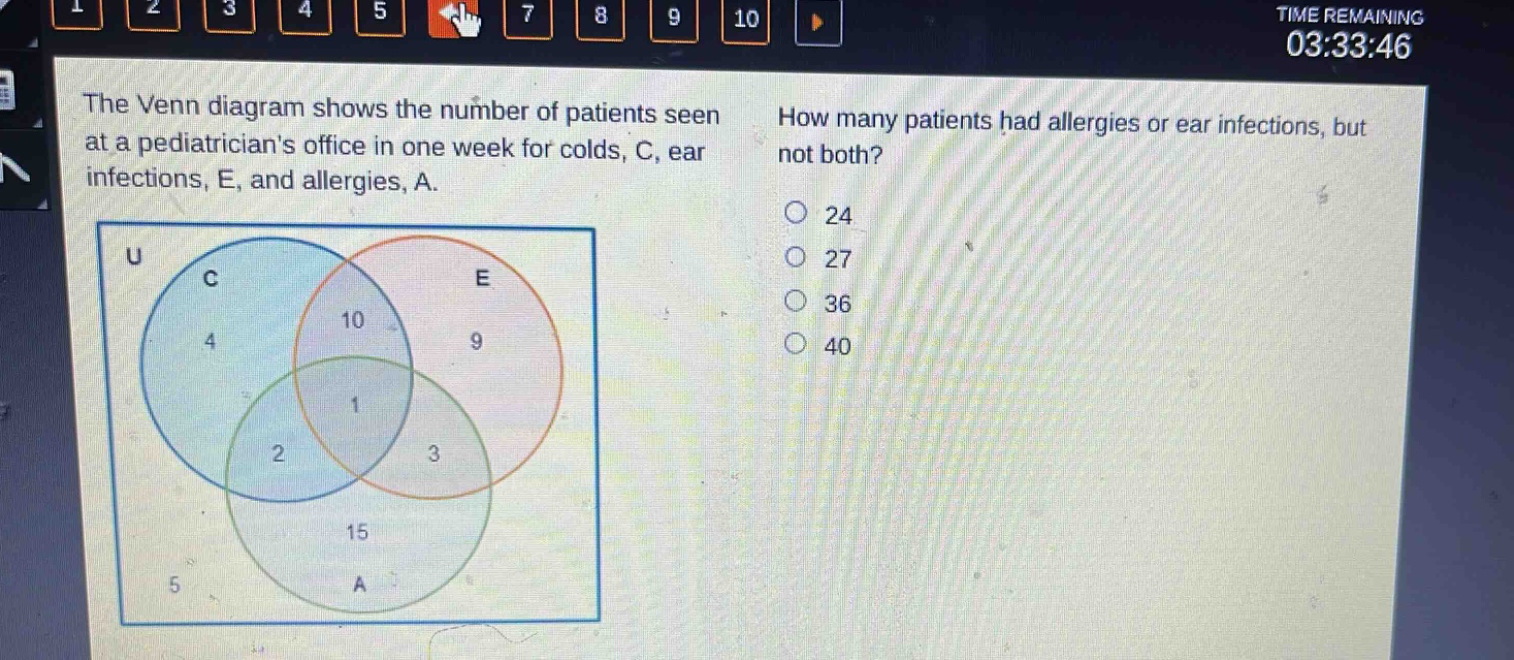
the venn diagram shows the number of patients seen at a pediatricians office in one week for colds, c, ear infections, e, and allergies, a. how many patients had allergies or ear infections, but not both? 24 27 36 40
Answer
Explanation:
Step1: Identify the regions for ear infections only and allergies only
For ear infections only: (9) (from the region of (E) that doesn't overlap with (A) and (C) except the part we don't need here, specifically just the non - overlapping part of (E) with (A)). For allergies only: (15) (from the region of (A) that doesn't overlap with (E) and (C) except the part we don't need here, specifically just the non - overlapping part of (A) with (E)).
Step2: Sum the two regions
(9 + 15+3 + 2) (the (3) is the part of (A) that only overlaps with (E) and the (2) is the part of (A) that only overlaps with (C)). Wait, no, re - check. Wait, patients with allergies or ear infections but not both: for ear infections ((E)) only (not overlapping with (A)) is (9), for allergies ((A)) only (not overlapping with (E)) is (15), and the part of (A) that only overlaps with (C) (since we want (A) or (E) not both (A) and (E)) is (2), the part of (E) that only overlaps with (C) (since we want (A) or (E) not both (A) and (E)) is (10) are not relevant. Wait, no, correct approach: (n((A\cup E)- (A\cap E))=n(A - E)+n(E - A)). (n(A - E)=15 + 2) (all parts of (A) not in (E)), (n(E - A)=9+10) (no, wait no, no. Wait the formula for (|(A\cup E)-(A\cap E)|=|A|+|E|-2|A\cap E|). But from Venn: (A) values (excluding (C) intersections but relevant for (A) or (E) not both): (15) (only (A)) (+3) ((A\cap E) only, no (C)) and (E) values (excluding (C) intersections but relevant for (A) or (E) not both): (9) (only (E)) (+10) ((E\cap C) but no, wait no. Wait the correct regions: patients with allergies or ear infections but not both: regions for (A) only ((15)) and (E) only ((9)) and (A) with (C) only ((2)) and (E) with (C) only ((10)) are not. Wait no! Wait the formula (n((A\cup E)- (A\cap E))=(15 + 2+3)+(9 + 10+1)-2(1 + 3)) no, wrong. Wait, no. The correct regions: for (A) or (E) but not both (A) and (E): look at the Venn. The region for (A) not in (E): (15+2) (but (2) is (A\cap C) not (A\cap E)), the region for (E) not in (A): (9 + 10) (but (10) is (E\cap C) not (E\cap A)). No, wait the problem says "allergies or ear infections, but not both". So (A) only ((15)) and (E) only ((9)) and (A) with (C) (since (C) is another set, but the condition is about (A) and (E)): no, wait no. Wait in set - theoretic terms (|(A\cup E)-(A\cap E)|=(|A|+|E|-|A\cap E|)-|A\cap E|=|A|+|E|-2|A\cap E|). From Venn: (|A|=15 + 2+1+3=21), (|E|=9 + 10+1+3=23), (|A\cap E|=1 + 3=4). Then (21+23-2\times4=21 + 23-8=36).
Answer:
36