5. the venn diagram below shows survey results of cities visited by a group of people on a recent trip to…
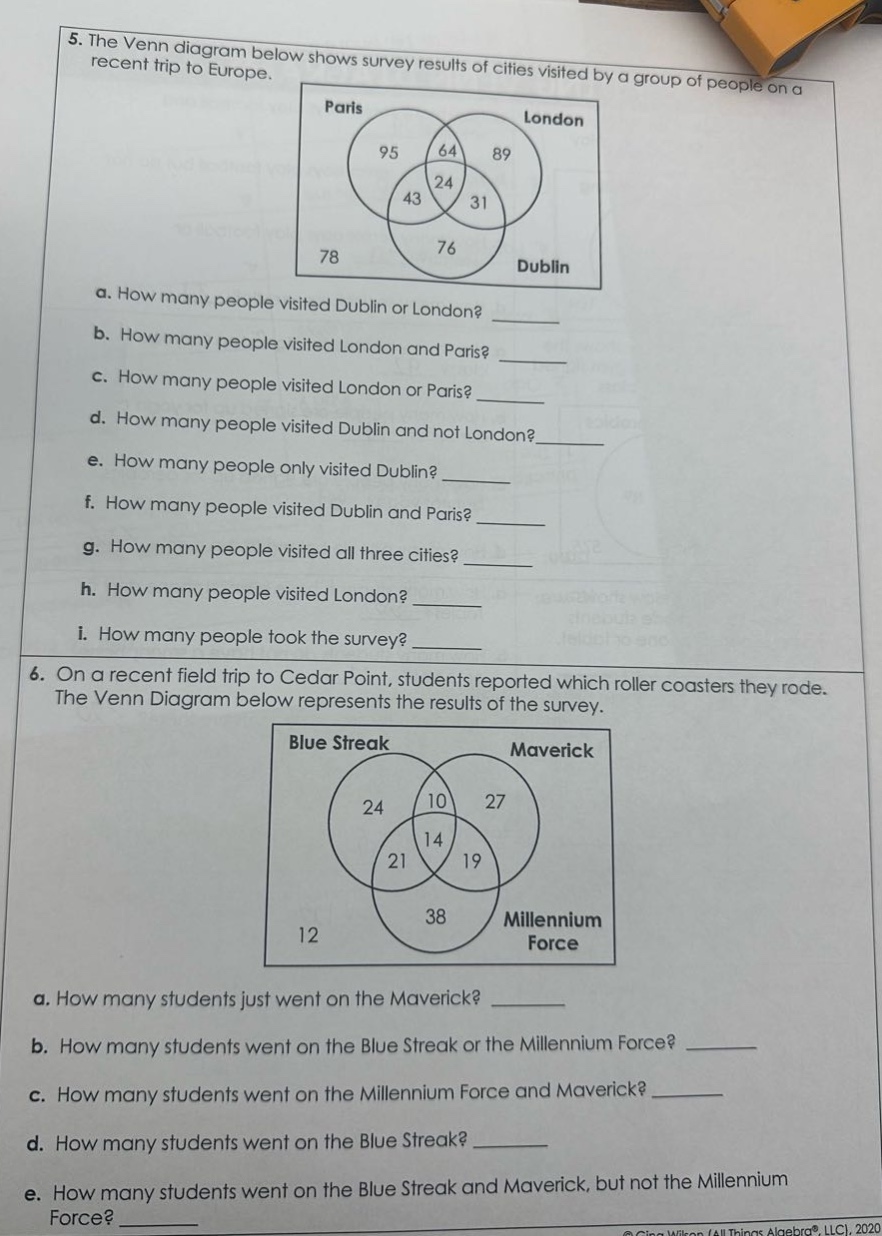
5. the venn diagram below shows survey results of cities visited by a group of people on a recent trip to europe.\n\na. how many people visited dublin or london?\n\nb. how many people visited london and paris?\n\nc. how many people visited london or paris?\n\nd. how many people visited dublin and not london?\n\ne. how many people only visited dublin?\n\nf. how many people visited dublin and paris?\n\ng. how many people visited all three cities?\n\nh. how many people visited london?\n\ni. how many people took the survey?\n\n6. on a recent field trip to cedar point, students reported which roller coasters they rode. the venn diagram below represents the results of the survey.\n\na. how many students just went on the maverick?\n\nb. how many students went on the blue streak or the millennium force?\n\nc. how many students went on the millennium force and maverick?\n\nd. how many students went on the blue streak?\n\ne. how many students went on the blue streak and maverick, but not the millennium force?
Answer
Explanation:
Step1: Encontrar el número de personas que visitaron Dublín o Londres (a)
Usamos la fórmula $n(D\cup L)=n(D)+n(L)-n(D\cap L)$. Aquí, $n(D) = 43 + 24+31 + 76=174$, $n(L)=64 + 24+31 + 89 = 208$, $n(D\cap L)=24 + 31=55$. Entonces $n(D\cup L)=174+208 - 55=327$.
Step2: Encontrar el número de personas que visitaron Londres y París (b)
$n(L\cap P)=64 + 24=88$.
Step3: Encontrar el número de personas que visitaron Londres o París (c)
Usamos la fórmula $n(L\cup P)=n(L)+n(P)-n(L\cap P)$. $n(P)=95 + 64+24 + 43=226$, $n(L) = 208$, $n(L\cap P)=88$. Entonces $n(L\cup P)=208+226 - 88=346$.
Step4: Encontrar el número de personas que visitaron Dublín y no Londres (d)
$n(D\cap\overline{L})=43 + 76=119$.
Step5: Encontrar el número de personas que solo visitaron Dublín (e)
Es 76.
Step6: Encontrar el número de personas que visitaron Dublín y París (f)
$n(D\cap P)=43 + 24=67$.
Step7: Encontrar el número de personas que visitaron las tres ciudades (g)
Es 24.
Step8: Encontrar el número de personas que visitaron Londres (h)
$n(L)=64 + 24+31 + 89 = 208$.
Step9: Encontrar el número de personas que hicieron la encuesta (i)
Sumamos todos los valores: $95+64 + 89+43+24+31+76+78=490$.
Para el segundo diagrama de Venn:
Step1: Encontrar el número de estudiantes que subieron solo al Maverick (a)
Es 27.
Step2: Encontrar el número de estudiantes que subieron al Blue Streak o al Millennium Force (b)
$n(BS\cup MF)=n(BS)+n(MF)-n(BS\cap MF)$. $n(BS)=24 + 10+21=55$, $n(MF)=21 + 14+19+38 = 92$, $n(BS\cap MF)=21$. Entonces $n(BS\cup MF)=55+92 - 21=126$.
Step3: Encontrar el número de estudiantes que subieron al Millennium Force y al Maverick (c)
$n(MF\cap M)=14 + 19=33$.
Step4: Encontrar el número de estudiantes que subieron al Blue Streak (d)
$n(BS)=24 + 10+21=55$.
Step5: Encontrar el número de estudiantes que subieron al Blue Streak y al Maverick, pero no al Millennium Force (e)
Es 10.
Answer:
a. 327 b. 88 c. 346 d. 119 e. 76 f. 67 g. 24 h. 208 i. 490 a (segundo diagrama): 27 b (segundo diagrama): 126 c (segundo diagrama): 33 d (segundo diagrama): 55 e (segundo diagrama): 10