while playing a board game, players start their turn by rolling a six - sided die numbered 1 through 6…
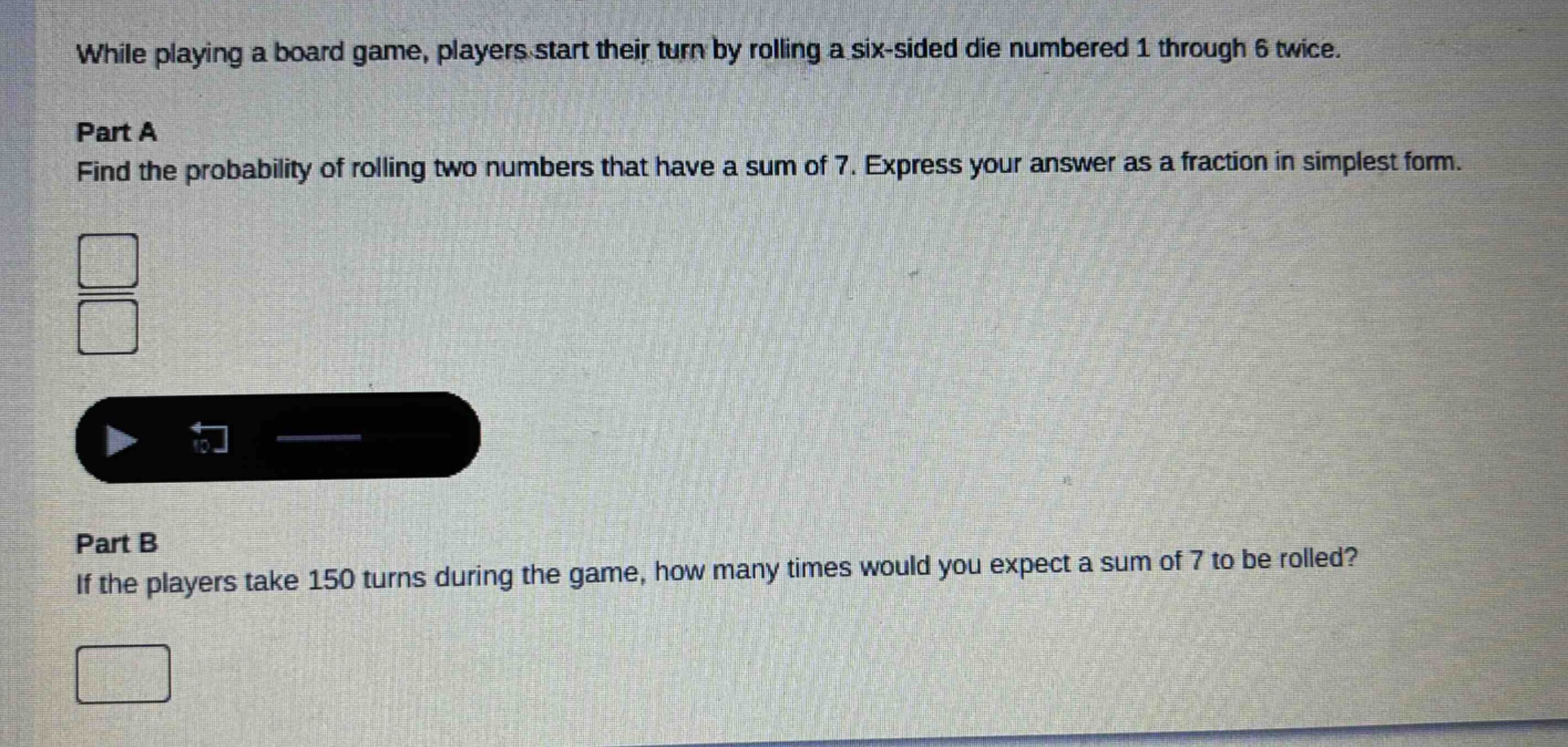
while playing a board game, players start their turn by rolling a six - sided die numbered 1 through 6 twice.\npart a\nfind the probability of rolling two numbers that have a sum of 7. express your answer as a fraction in simplest form.\n\npart b\nif the players take 150 turns during the game, how many times would you expect a sum of 7 to be rolled?
Answer
Explanation:
Step1: Find total number of outcomes
When rolling a six - sided die twice, the total number of outcomes is $6\times6 = 36$ since for the first roll there are 6 possibilities and for each of those, the second roll has 6 possibilities.
Step2: Find number of favorable outcomes
The pairs of numbers that sum to 7 when rolling two dice are $(1,6)$, $(2,5)$, $(3,4)$, $(4,3)$, $(5,2)$, $(6,1)$. So there are 6 favorable outcomes.
Step3: Calculate probability for Part A
The probability $P$ of an event is the number of favorable outcomes divided by the total number of outcomes. So $P=\frac{6}{36}=\frac{1}{6}$.
Step4: Calculate expected value for Part B
The expected value $E$ of a binomial - like situation (repeated independent trials) is given by $E = n\times P$, where $n$ is the number of trials and $P$ is the probability of success in a single trial. Here, $n = 150$ and $P=\frac{1}{6}$. So $E=150\times\frac{1}{6}=25$.
Answer:
Part A: $\frac{1}{6}$ Part B: 25