in a word game, a player randomly picks a letter from each of the two bags.\n- the first bag contains the…
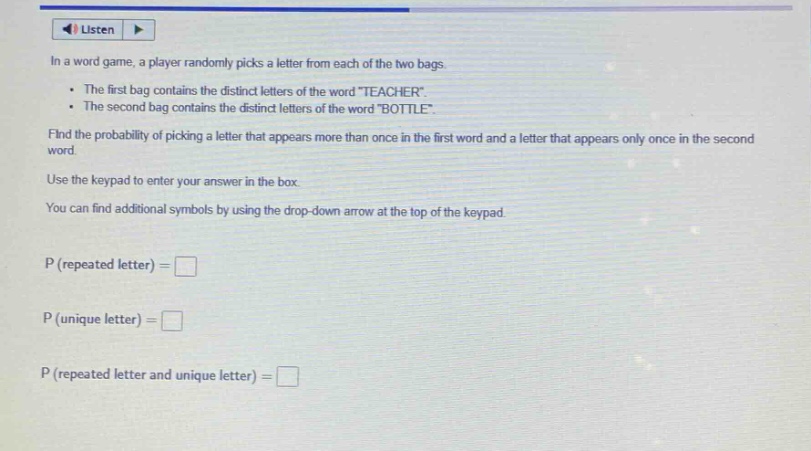
in a word game, a player randomly picks a letter from each of the two bags.\n- the first bag contains the distinct letters of the word \teacher\.\n- the second bag contains the distinct letters of the word \bottle\.\nfind the probability of picking a letter that appears more than once in the first word and a letter that appears only once in the second word.\nuse the keypad to enter your answer in the box.\nyou can find additional symbols by using the drop - down arrow at the top of the keypad.\np (repeated letter) =\np (unique letter) =\np (repeated letter and unique letter) =
Answer
Answer:
- For (P(\text{repeated letter})): (\frac{2}{7})
- For (P(\text{unique letter})): (\frac{4}{6})
- For (P(\text{repeated letter and unique letter})): (\frac{4}{21})
Explanation:
Step1: Analyze first - bag letters
The word "TEACHER" has 7 distinct letters: T, E, A, C, H, E, R. The repeated letter is 'E' (2 times). So the probability of picking a repeated letter from the first bag is the number of repeated - letter types divided by the total number of letters in the first bag. There is 1 type of repeated letter ('E') out of 7 letters, so (P(\text{repeated letter})=\frac{2}{7}).
Step2: Analyze second - bag letters
The word "BOTTLE" has 6 distinct letters: B, O, T, T, L, E. The non - repeated letters are B, L, E. There are 4 non - repeated letters out of 6. So (P(\text{unique letter})=\frac{4}{6}).
Step3: Calculate joint probability
Since the events of picking from the first bag and the second bag are independent, the joint probability (P(A\cap B)=P(A)\times P(B)). Here, (A) is the event of picking a repeated letter from the first bag and (B) is the event of picking a unique letter from the second bag. So (P(\text{repeated letter and unique letter})=\frac{2}{7}\times\frac{4}{6}=\frac{4}{21}).