write the letter of the correct answer on the line at left. 17. minerals can be differentiated by their…
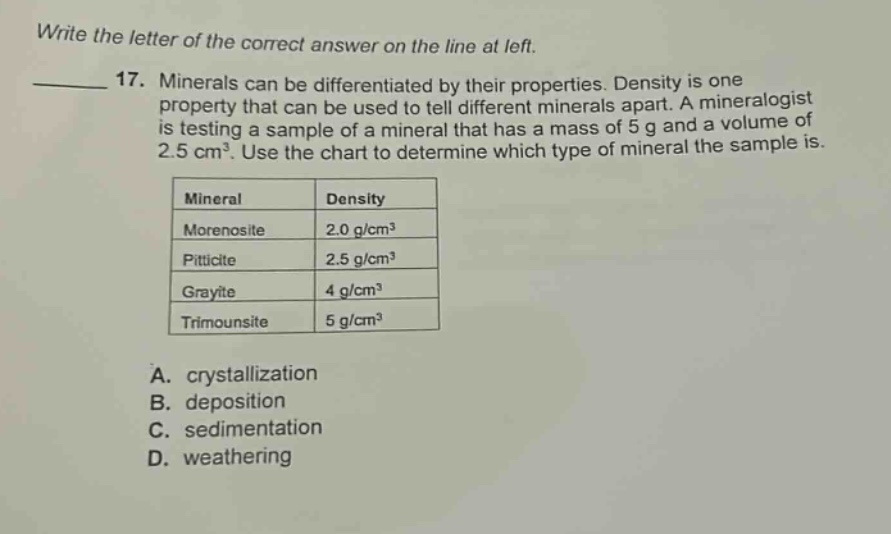
write the letter of the correct answer on the line at left. 17. minerals can be differentiated by their properties. density is one property that can be used to tell different minerals apart. a mineralogist is testing a sample of a mineral that has a mass of 5 g and a volume of 2.5 cm³. use the chart to determine which type of mineral the sample is. mineral density morenosite 2.0 g/cm³ piticite 2.5 g/cm³ grayite 4 g/cm³ trimounsite 5 g/cm³ a. crystallization b. deposition c. sedimentation d. weathering
Answer
Explanation:
Step1: Recall density formula
The density formula is $\rho=\frac{m}{V}$, where $\rho$ is density, $m$ is mass and $V$ is volume.
Step2: Calculate density of sample
Given $m = 5\ g$ and $V=2.5\ cm^{3}$, then $\rho=\frac{5\ g}{2.5\ cm^{3}} = 2\ g/cm^{3}$.
Step3: Match with chart
From the chart, the mineral with a density of $2.0\ g/cm^{3}$ is Morenosite.
Answer:
A. Morenosite