if p(not yellow) = $\frac{4}{15}$, which best describes the probability of the complement of the…
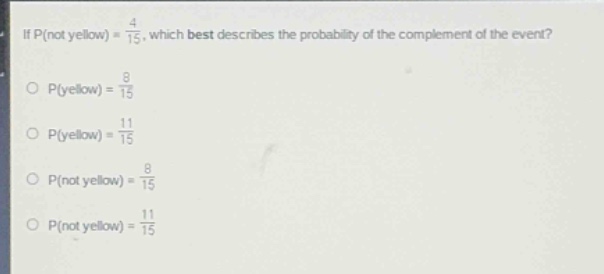
if p(not yellow) = $\frac{4}{15}$, which best describes the probability of the complement of the event?\np(yellow) = $\frac{8}{15}$\np(yellow) = $\frac{11}{15}$\np(not yellow) = $\frac{8}{15}$\np(not yellow) = $\frac{11}{15}$
Answer
Answer:
P(yellow) = $\frac{11}{15}$
Explanation:
Step1: Recall complement rule
The probability of an event $A$ and its complement $\overline{A}$ satisfy $P(A)+P(\overline{A}) = 1$.
Step2: Identify events
Let $A$ be the event "yellow" and $\overline{A}$ be the event "not yellow". We know $P(\overline{A})=\frac{4}{15}$.
Step3: Calculate $P(A)$
Using the formula $P(A)=1 - P(\overline{A})$, we substitute $P(\overline{A})=\frac{4}{15}$ into it. So $P(A)=1-\frac{4}{15}=\frac{15 - 4}{15}=\frac{11}{15}$.