you pick a card at random. without putting the first card back, you pick a second card at random. what is…
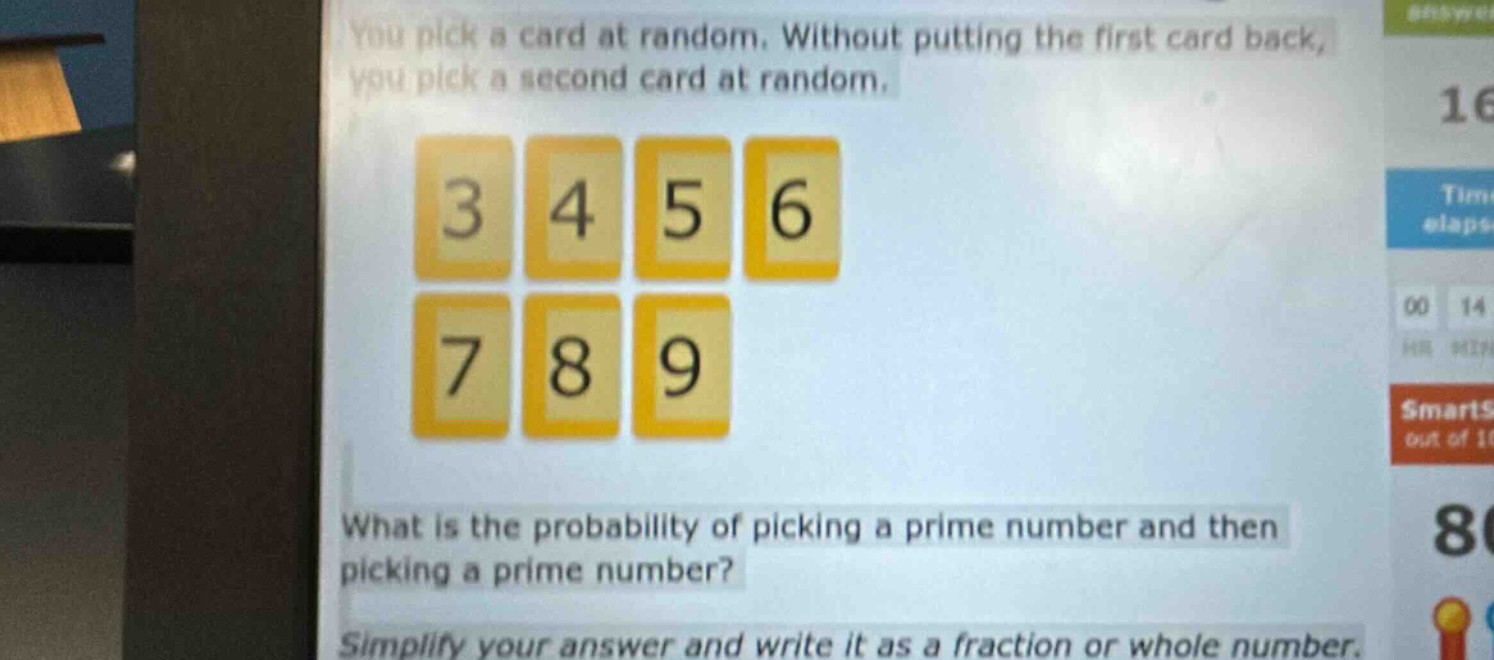
you pick a card at random. without putting the first card back, you pick a second card at random. what is the probability of picking a prime number and then picking a prime number? simplify your answer and write it as a fraction or whole number.
Answer
Explanation:
Step1: Count prime - numbers and total numbers
The prime numbers in the set {3, 4, 5, 6, 7, 8, 9} are 3, 5, 7. So there are 3 prime numbers and 7 total numbers.
Step2: Calculate the probability of the first pick
The probability of picking a prime number on the first pick is the number of prime numbers divided by the total number of numbers. So (P_1=\frac{3}{7}).
Step3: Calculate the probability of the second pick
Since we do not put the first - card back, there are now 6 total numbers left. If the first number was prime, there are 2 prime numbers left. So the probability of picking a prime number on the second pick given that the first number was prime is (P_2 = \frac{2}{6}=\frac{1}{3}).
Step4: Calculate the combined probability
For two dependent events, the probability of both events occurring is the product of their probabilities. So (P = P_1\times P_2=\frac{3}{7}\times\frac{1}{3}). [P=\frac{3\times1}{7\times3}=\frac{1}{7}]
Answer:
(\frac{1}{7})