you pick a card at random. without putting the first card back, you pick a second card at random. what is…
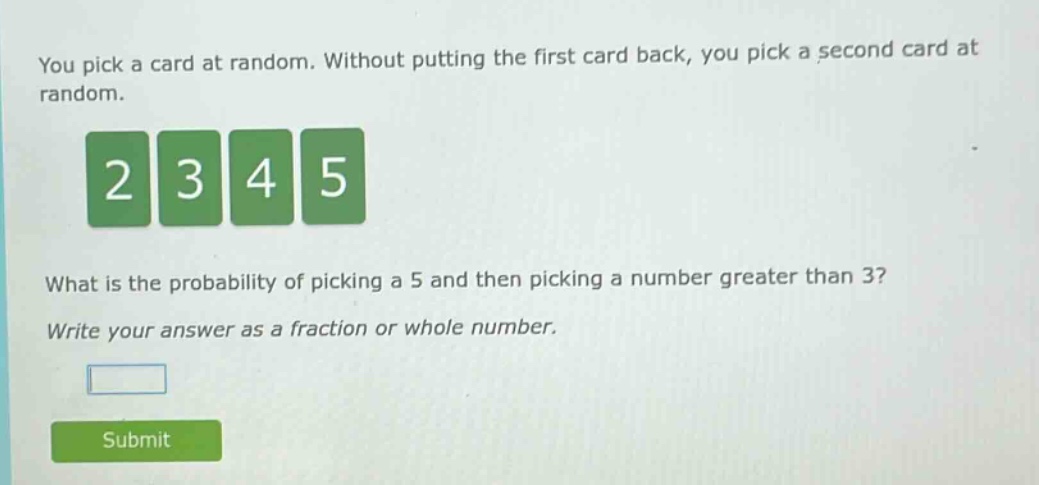
you pick a card at random. without putting the first card back, you pick a second card at random. what is the probability of picking a 5 and then picking a number greater than 3? write your answer as a fraction or whole number.
Answer
Explanation:
Step1: Calculate probability of picking 5 first
There are 4 cards in total. The probability of picking a 5 on the first - draw is $P(5)=\frac{1}{4}$.
Step2: Calculate probability of picking a number greater than 3 on the second - draw given 5 was picked first
If a 5 was picked first (without replacement), then there are 3 cards left. The numbers greater than 3 among the remaining cards are 2 (4 and the non - picked card if 5 was picked first). So the probability of picking a number greater than 3 on the second draw given that 5 was picked first is $P(\text{>3}|5)=\frac{2}{3}$.
Step3: Calculate the joint probability
By the multiplication rule for conditional probability $P(A\cap B)=P(A)\times P(B|A)$. Here, $A$ is the event of picking 5 first and $B$ is the event of picking a number greater than 3 second. So $P = \frac{1}{4}\times\frac{2}{3}=\frac{2}{12}=\frac{1}{6}$.
Answer:
$\frac{1}{6}$