you pick a card at random. without putting the first card back, you pick a second card at random. what is…
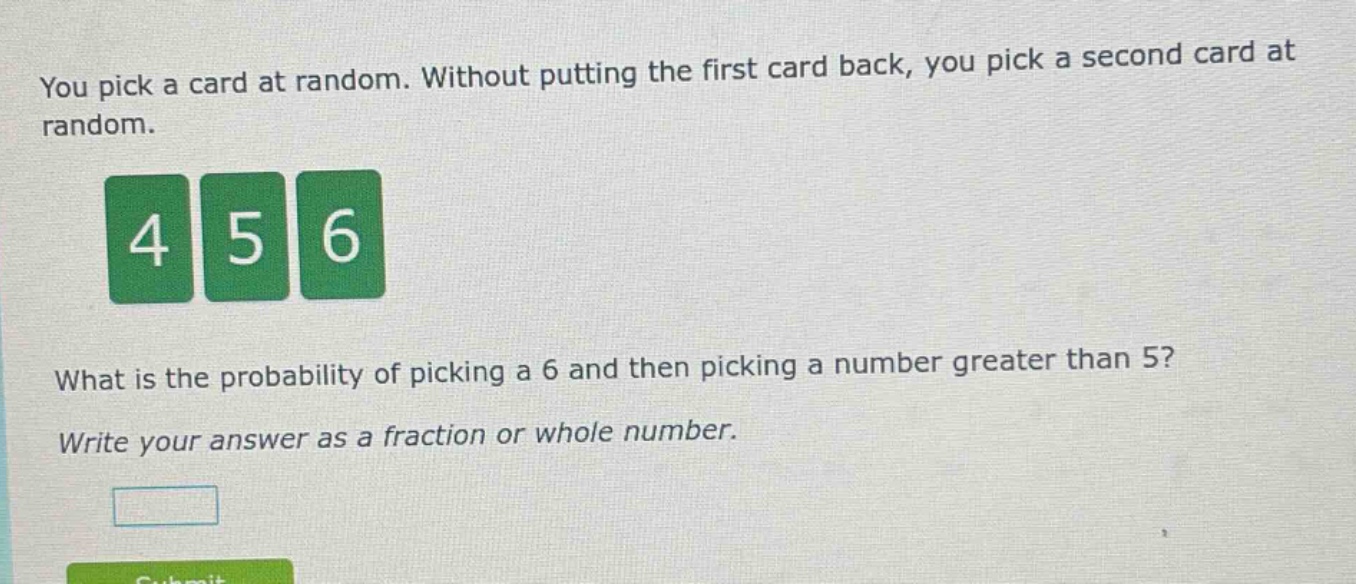
you pick a card at random. without putting the first card back, you pick a second card at random. what is the probability of picking a 6 and then picking a number greater than 5? write your answer as a fraction or whole number.
Answer
Answer:
$\frac{1}{6}$
Explanation:
Step1: Calculate probability of picking 6 first
There are 3 cards. The probability of picking a 6 first is $\frac{1}{3}$.
Step2: Calculate probability of picking number > 5 second
After picking 6 first (without replacement), there are 2 cards left. The only number greater than 5 among the remaining cards is none (since 6 is already picked), but if we consider the general - case of picking a number greater than 5 after picking 6 first, the probability of picking a number greater than 5 from the remaining 2 cards is $\frac{0}{2}$ (if we assume we want a non - 6 number greater than 5) or in the context of the remaining valid cases after picking 6 first, the probability of picking the remaining non - used card (in a sense of the sequence) is $\frac{1}{2}$.
Step3: Calculate joint probability
Since these are dependent events, we multiply the probabilities. $\frac{1}{3}\times\frac{1}{2}=\frac{1}{6}$.