are you ready for more? each of the whole numbers from 1 to 25 is written on a slip of paper and placed in a…
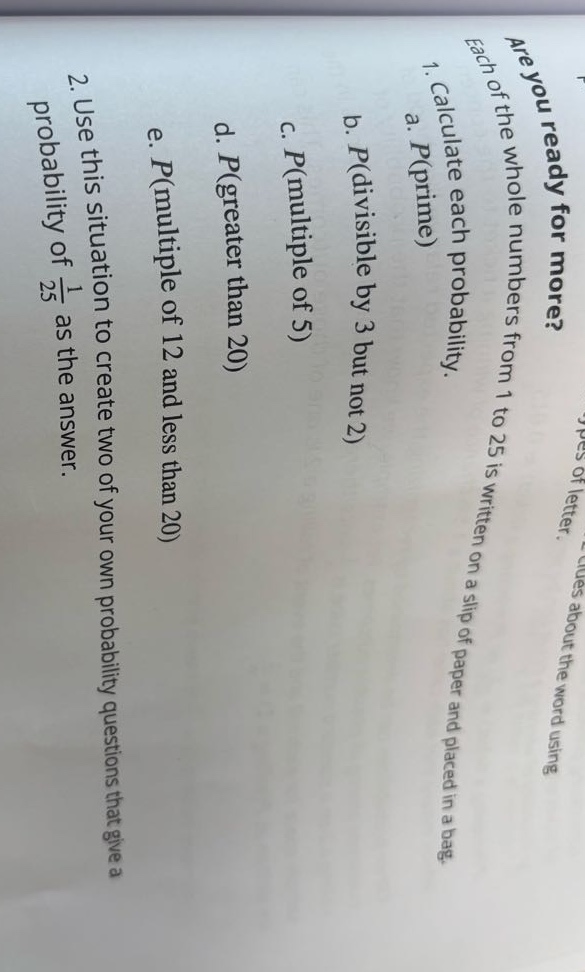
are you ready for more? each of the whole numbers from 1 to 25 is written on a slip of paper and placed in a bag. 1. calculate each probability. a. p(prime) b. p(divisible by 3 but not 2) c. p(multiple of 5) d. p(greater than 20) e. p(multiple of 12 and less than 20) 2. use this situation to create two of your own probability questions that give a probability of 1/25 as the answer.
Answer
Explanation:
Step1: Count total numbers
There are 25 whole numbers from 1 to 25, so the total number of outcomes $n = 25$.
Step2: Find prime numbers
Prime numbers from 1 - 25 are 2, 3, 5, 7, 11, 13, 17, 19, 23. So $n_{a}=9$. Then $P(\text{prime})=\frac{n_{a}}{n}=\frac{9}{25}$.
Step3: Find numbers divisible by 3 but not 2
Numbers divisible by 3 are 3, 6, 9, 12, 15, 18, 21, 24. Removing those divisible by 2 (6, 12, 18, 24), we get 3, 9, 15, 21. So $n_{b}=4$. Then $P(\text{divisible by 3 but not 2})=\frac{n_{b}}{n}=\frac{4}{25}$.
Step4: Find multiples of 5
Multiples of 5 from 1 - 25 are 5, 10, 15, 20, 25. So $n_{c}=5$. Then $P(\text{multiple of 5})=\frac{n_{c}}{n}=\frac{5}{25}=\frac{1}{5}$.
Step5: Find numbers greater than 20
Numbers greater than 20 from 1 - 25 are 21, 22, 23, 24, 25. So $n_{d}=5$. Then $P(\text{greater than 20})=\frac{n_{d}}{n}=\frac{5}{25}=\frac{1}{5}$.
Step6: Find multiples of 12 less than 20
The only multiple of 12 less than 20 is 12. So $n_{e}=1$. Then $P(\text{multiple of 12 and less than 20})=\frac{n_{e}}{n}=\frac{1}{25}$.
Answer:
a. $\frac{9}{25}$ b. $\frac{4}{25}$ c. $\frac{1}{5}$ d. $\frac{1}{5}$ e. $\frac{1}{25}$