you spin both spinners. what is the probability of spinning a on the first spinner and a number greater than…
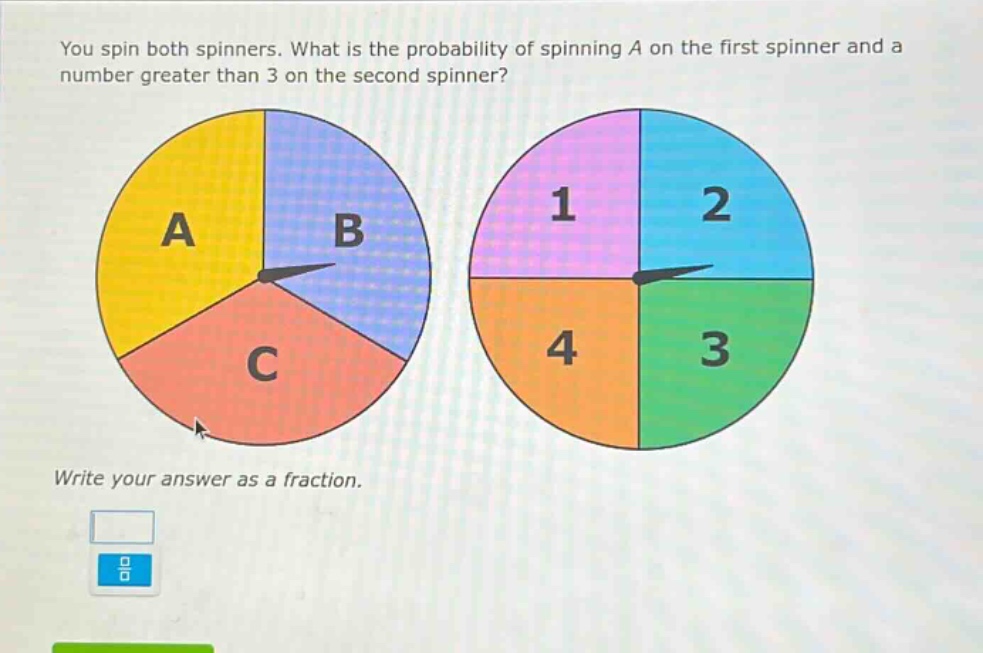
you spin both spinners. what is the probability of spinning a on the first spinner and a number greater than 3 on the second spinner? write your answer as a fraction.
Answer
Explanation:
Step1: Calculate probability of spinning A
The first spinner is divided into 3 equal - parts. The probability of spinning A, denoted as $P(A)$, is $\frac{1}{3}$ since there is 1 part labeled A out of 3 total parts.
Step2: Calculate probability of spinning a number greater than 3
The second spinner is divided into 4 equal - parts. The numbers greater than 3 on the second spinner is 4, so there is 1 number greater than 3 out of 4 total numbers. The probability of spinning a number greater than 3, denoted as $P(\text{>3})$, is $\frac{1}{4}$.
Step3: Use the multiplication rule for independent events
Since the two spins are independent events, the probability of both events occurring is the product of their individual probabilities. So $P = P(A)\times P(\text{>3})$. Substitute $P(A)=\frac{1}{3}$ and $P(\text{>3})=\frac{1}{4}$ into the formula: $P=\frac{1}{3}\times\frac{1}{4}=\frac{1}{12}$.
Answer:
$\frac{1}{12}$