you toss two number cubes. if a sum of 7 or 11 comes up, you get 7 points, if not you lose 2 points. the…
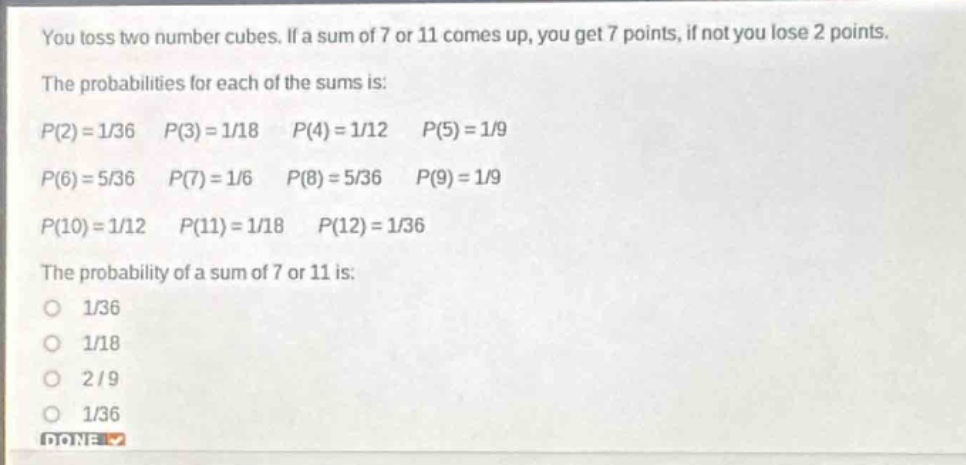
you toss two number cubes. if a sum of 7 or 11 comes up, you get 7 points, if not you lose 2 points. the probabilities for each of the sums is: p(2)=1/36 p(3)=1/18 p(4)=1/12 p(5)=1/9 p(6)=5/36 p(7)=1/6 p(8)=5/36 p(9)=1/9 p(10)=1/12 p(11)=1/18 p(12)=1/36 the probability of a sum of 7 or 11 is: 1/36 1/18 2/9 1/36 done
Answer
Explanation:
Step1: Identify relevant probabilities
We know $P(7)=\frac{1}{6}$ and $P(11)=\frac{1}{18}$.
Step2: Use addition - rule for mutually - exclusive events
Since getting a sum of 7 and getting a sum of 11 are mutually - exclusive events, the probability of getting a sum of 7 or 11 is $P(7\ or\ 11)=P(7)+P(11)$. $P(7)+P(11)=\frac{1}{6}+\frac{1}{18}$. First, find a common denominator, which is 18. Then $\frac{1}{6}=\frac{3}{18}$. So $\frac{3}{18}+\frac{1}{18}=\frac{3 + 1}{18}=\frac{4}{18}=\frac{2}{9}$.
Answer:
$\frac{2}{9}$